Search this site
628 results found with an empty search
- Seafood Stuffed Shrimp Russula Caps | Fungus Federation of Santa Cruz
Seafood Stuffed Shrimp Russula Caps Young shrimp russulas have a mild, nutty taste, and work well with seafood dishes. by Gregg Ferguson Russula xerampelina. © Natalynn Browning (CC-BY-NC) (from inaturalist.org, obs. 35720366) Method Soften cream cheese by leaving it on the counter until it reaches room temperature (30 to 45 minutes). In the meantime, pat shrimp dry with paper towels, then season lightly with salt and pepper. Sauté shrimp in a skillet with 1 tsp. of oil or butter over medium-high heat for 1 to 2 minutes per side, just until opaque and pink. Remove shrimp from skillet immediately and set aside to cool to room temperature. Blanch the scallops: Bring a small pot of salted water to a gentle boil. Drop in scallops and cook for 45 to 60 seconds until they turn opaque and firm up slightly. Immediately transfer scallops to a bowl of ice water to stop the cooking process, then drain well. Preheat oven to 400°F Gently clean shrimp russula caps, and remove the stems. (Save stems to use in other dishes) Arrange caps on baking pan. Finely chop the cooled shrimp, scallops, and crab meat. Squeeze out the excess moisture and discard. Place seafood in a bowl and add the softened cream cheese, eggs, and seasonings. Mix well. Stuff caps with the seafood/dairy mixture. Melt butter in microwave or small saucepan, and drizzle over each cap. Sprinkle each cap with Parmesan cheese. Bake at 400°F for until mushrooms are tender and hot, and cheese is browned (12 to 15 minutes). Recipe contributed: October 1986 Objective: Appetizer Total Time: 1 to 1 ¼ hours Yield: 6 to 8 servings Suggested Mushrooms: Shrimp russula (Russula xerampelina) Join FFSC or renew your membership to access the rest of this content. Join FFSC Login as an FFSC member to access the rest of this content. Login Ingredients ½ lb. peeled and deveined shrimp ¼ lb. scallops 2 oz. cooked crab meat 3 oz. cream cheese 2 to 3 Tbsp. butter ¼ cup grated Parmesan cheese (or more, to taste) 1 egg ¼ tsp. garlic powder ½ tsp. dry mustard Pinch white pepper ¼ tsp. salt 20-30 small shrimp russulas Previous Recipe All Recipes Next Recipe
- Become a Fair Volunteer | Fungus Federation of Santa Cruz
Become a Fair Volunteer We need volunteers to set up and run the 2026 Fungus Fair. Honestly, we can't do it without you! What Do Volunteers Do? Ready to sign up? Here's how . During the Fair (Jan 9-11) Help with ticket sales and voucher redemption Check hand stamps Set up and/or take down tables and chairs for the After Hours Dinner Help at the FFSC membership table The central island ready to receive the fungi from volunteers. Photo by Katherine Elvin Before the Fair Collect wild mushrooms for the exhibits (January 6-7) Help arrange the mushroom exhibits (January 7-9) Load and unload tables, chairs, equipment, etc. for the Fungi Forest, talks, and craft areas (January 6-9) Help to plan the Fair (June - December) At the End of (and After) the Fair Take down all the exhibits (January 11) Fold and store all the tables and chairs (January 11) Celebrate a job well done at the Volunteer Dinner! (TBA) Ready to sign up? How to Become a Fair Volunteer 301 Center St, Santa Cruz, CA 95060, USA Anyone can help! You do not need to be a member of FFSC to volunteer. To be eligible for a FREE General Admission ticket to the Fungus Fair, you must pre-register as a volunteer, and work for at least one volunteer position (usually for a few hours, depending on the role). If there is an area or task you particularly enjoy, it's a good idea to sign up early to nail it down now. To volunteer during the Fair (Friday, Saturday, Sunday), please visit: https://ffsc.ivolunteer.com/fungusfair_2026 To volunteer for set up before the Fair, or take down at the end of the Fair, please visit: https://ffsc.ivolunteer.com/setup_2026
- Oyster Mushroom Bruschetta | Fungus Federation of Santa Cruz
Oyster Mushroom Bruschetta Bruschetta is always popular at our FFSC potlucks, and this recipe would be no exception! by Deb Pleurotus ostreatus. © Felicia Gershberg (CC-BY-NC) (from inaturalist.org, obs. 326553944) Method Slice the bread 1" thick. Grill or broil the bread on each side until lightly browned. Rub each slice with crushed garlic, and brush with olive oil and salt to taste. Heat olive oil in frying pan over medium-high heat. Add garlic and cook, stirring for about 30 seconds. Add the mushrooms, cooking until they give up moisture. Add herbs and continue cooking until mushrooms are nicely browned. Top bread with one or two thin tomato slices. Add hot cooked mushrooms, and serve warm. Recipe contributed: November 1996 I had a particularly enjoyable September, which involved at various times mudbaths, hot mineral soaks, massage, wine, food, and, of course, mushrooms. You know, the usual FFSC stuff! Between a trip to the wine country with my big sisters and the Echo Summit Foray, it was a great month. The progressive Saturday potluck at Echo was the usual fabulous decadence; hedonism followed in the spa and casinos! The following recipe is my approximation of a great appetizer I had at the Culinary Institute of America at Greystone in St. Helena. The CIA is in the old Christian Brothers winery, offering tours, kitchen viewing and a great restaurant for lunch or dinner. Objective: Appetizer Total Time: 20 to 30 mins Yield: 6 servings Suggested Mushrooms: Oyster / king oyster mushroom (Pleurotus eryngii, Pleurotus ostreatus) Join FFSC or renew your membership to access the rest of this content. Join FFSC Login as an FFSC member to access the rest of this content. Login Ingredients Bruschetta 6 slices good bread (chewy, porous textured with a good crust) 2 or 2 cloves garlic Good olive oil Salt, preferably kosher or sea salt Mushrooms A nice pile of fresh oyster mushrooms, sliced if large 1 or 2 garlic cloves, peeled and minced Olive oil Fresh rosemary or fresh thyme (or use both or other herbs of choice) Salt & pepper to taste Previous Recipe All Recipes Next Recipe
- In Memory of Herb Saylor | Fungus Federation of Santa Cruz
News & Stories / In Memory of Herb Saylor The mushroom community in the San Francisco Bay Area is feeling the heavy loss of one of the GIANTS in the local mycology scene. Herb Saylor died at work from a heart attack in May. Larry Stickney • May 25, 2000 Ramaria stricta. © Lila (CC-BY-NC) (inaturalist.org, obs. 339502924) He influenced so many amateurs and even spurred many to get a college degree. This includes Dr. Dennis Desjardin and several other Ph.D's in mycology. He spent his spare money buying taxonomy books for the graduate students at SFSU and twice served as President of the MSSF. He was constantly teaching about mushroom taxonomy and microscopy, leading forays and talking about the fungi to anyone who would listen. He was an expert on the corals and hypogeous fungi, but well rounded in all areas and one of the most knowledgeable amateurs in North America. Herb was loved and respected by all and he will be sadly missed. Members Only Content Login Join FFSC Related Posts Previous Article All News & Stories Next Article
- Yikes! Theres a Fly in My Mushroom! | Fungus Federation of Santa Cruz
News & Stories / Mycology & Art News Yikes! Theres a Fly in My Mushroom! There’s more than just a little extra protein in there! Take a few minutes to get a real inside look at the diligent workers who put the “mush” in mushroom (along with some edibility tips). Hannah Nadel • May 1, 2007 Leccinum manzanitae. © Alan Rockefeller (from mushroomobserver.org) Hannah Nadel (from researchgate.net) Hannah Nadel is a research entomologist, currently with the USDA-Agricultural Research Service in Parlier, CA. She learned mushroom ID through the Los Angeles Mycological Society in the early 1980s while a graduate student at UC Riverside. While in Victoria, BC, Hannah helped found the South Vancouver Island Mycological Society. A tenderhearted soul, she felt bad about all the maggotty mushrooms being chucked out along the trailsides and decided to rear the larvae to the adult stage to identify what species prefer to breed in particular mushrooms. This led to maggoty piles deposited mysteriously on her doorstep after dark and to maggotty mushroom soup in jacket pockets many days after a stroll in the woods. --Debbie Johnson Editors' Note: This article was reprinted with permission from the August 1994 issue of Fungifama , the newsletter of the South Vancouver Island Mycological Society. The original article is still available as a PDF online, but we are reproducing it here in case that changes in the future. (We also added a few photos to this version.) On a recent plant and insect collecting trip to the southern interior of British Colombia I noticed an interesting human behavior. Oluna Ceska, who seems sane enough, was patting Leccinum mushrooms. After beaming with delight as she spotted each of the rather sporadic Leccinums along the footpath through the woods, Oluna’s expression would change to one of hopeful apprehension as she stooped and patted the brownish cap. She then either picked the mushroom with a triumphant cry, or muttered sounds of disappointment and moved quickly on, her eyes sweeping the ground for further possibilities. Efficient Foragers When animals forage for food, they try to be as efficient as possible. Time is limited and they have much to do. They must find food, eat, wash, sleep, find mates, build nests, and produce and rear offspring within a limited lifetime. Spending too much time on one necessary activity may result in too little time spent on another, and the animal or its offspring could suffer. Clearly, the animal which spends the least amount of time deciding whether something is edible will have more time to spend looking for more food, and will, presumably, end up finding and eating more than a similar animal that spends a lot of time examining a potential tidbit to decide whether it is edible or not. Leccinum scabrum . © Ron Pastorino (from mykoweb.com) What Oluna was doing, I discovered, was minimizing the amount of time she spent deciding whether an edible mushroom was fit for the table or too riddled with worms to bother with (I’m assuming the technique works with mushrooms other than Leccinum ). Rather than pick the mushroom, cut it open, and examine its flesh, she learned that a mushroom that feels firm to the touch is relatively worm-free, and that those that feel spongey or punky are riddled with worm burrows. She can test this with one or two quick pats. As well, Oluna had already reduced the amount of time she has to spend per trip deciding if a mushroom is edible, because she has learned to identify many edible species by sight and doesn’t pat the bad-tasting or poisonous ones. But this story was not meant to be about time management in the life of a mushroom eater. Rather, it was meant to touch on the all-too-familiar “worms” that can turn a mushroom-eater’s delight to dolor, and a mushroom to, well, mush. Too often I get asked about what’s tunneling in a favorite edible, so I’ll give a brief account of what you might find in British Colombia. Are they really worms? First of all, like many things that are not what they seem to be, the worm-like creatures burrowing through your mushroom are not worms. They are insects. More specifically, they are the young of flies or, sometimes, beetles. Insects start their lives as eggs that hatch into larvae, and some, such as flies and beetles, undergo a resting stage, or pupa, before turning into winged adults (others change from larvae directly to adults). All growth occurs during the larval stage, and it’s therefore no surprise that this stage is the most voracious. These eating machines enlarge and fatten, and periodically shed their skin as they outgrow it, finally moulting into a resting pupal stage during which they metamorphose into winged adults. After escaping from the pupal skin, the adults may or may not feed, depending on the species, and they do not shed their skin again. They don’t grow, although the females may expand tremendously while carrying eggs. Fungus gnat larvae on potato slice, from Colorado State University website. In B.C., the most common fly larvae, or maggots, that you’ll find feeding in mushrooms belong to the fungus gnat family, the Mycetophilidae (pronounced my-see-toe-fill-id-ee, from the Greek words for fungus — mykes , and lover — philea ). They are not too hard to distinguish from other maggots in mushrooms because they have very dark heads and strong constrictions along their pale bodies. Like many other maggots, they are soft and thin-skinned, which makes them vulnerable to drying. Living inside a moist mushroom, or, in other cases, in rotting vegetation, protects them from drying and provides them with plenty of fungal tissue to feast on. The eggs are laid directly on the mushroom, usually on the underside in the spaces between the gills or in the pores (depending on what the mushroom has), and within a day or two the tiny, hatchlings begin feeding on these structures. At this stage the mushroom is still perfectly edible and the cap is firm. Bill McGuire found these boletes on the Spring Foray last year and is trying to contain his exuberance. Maybe he should have patted them first? Photo by Vernetta McGuire As they grow, the legless larvae burrow into the flesh of the stem and cap and literally eat themselves out of house and home. The burrows fill with digestive wastes and can be invaded by bacteria and other fungi; they generally appear rather brown or yellowish, and shouldn’t be eaten. If you find a mushroom with burrows in the stem only, it is quite safe to simply discard the stem and cook up the cap. By my standards, a few tunnels in the cap won’t hurt you either, but my gag threshold is perhaps higher than yours. When ready to pupate, after a week or so, fungus gnat larvae usually leave the rubble of the mushroom and pupate in the soil below it. After a few more days the dark, mosquito-like adults emerge, mate, and the females smell their way to a new mushroom on which to lay eggs. They usually prefer young mushrooms, perhaps because these will last longer and also probably because they’re racing against other fungus gnats (and/or other insects) to provide their own offspring with the advantage of being the first on a limited island of food. Miscellaneous Maggots Other maggots you might encounter in a mushroom are the smoother-bodied and pale-headed relatives of the small flies that visit your fruit bowl at home and feature in your genetics class at school. This family of fly is the Drosophilidae (pronounced dro-soh-fill-id-ee, from the Greek words for dew or sap — drosos , and lover — phileo ), also known as pomace flies or even as fruit flies, although they mustn’t be confused with the true fruit flies (family Tephritidae ). Larvae of pomace flies feed on fungi in rotting vegetation, fruit, sap flows on trees, or directly in mushrooms. Their life cycles resemble those of fungus gnats, so I won’t dwell on them further. The adults are quite different from the fungus gnats, being shaped more like a common housefly, but much smaller and usually colored a shiny honey-brown. Those of you who have studied genetics in school will remember the famous “fruit fly”, Drosophila melanogaster , the laboratory rat of the insect world, whose giant salivary-gland chromosomes and rapid reproduction have made it the darling of geneticists. The larvae of this species feed on fungi in rotting fruits. The adults carry fungi or spores on their feet to inoculate ripe, newly-bruised fruit on which they will lay their eggs. Sciara hemerobioides larva. © James Lindsay (from wikipedia.org) Many other families of flies feed at least partly on fungi, some on mushrooms, but most often on fungi that cause decay in plant material or dung. The dark-winged fungus gnats, family Sciaridae (sce-ar-i-dee), from the Greek skieros -shady, because they like shade), are often reported as pests in commercial mushroom houses. They also feed on fungi in decaying plant material such as rotting moss, which is why you might see hordes of them around your overwatered potted plants at home and in greenhouses. They are also rather mosquito-like, delicate and often minute, with dark gray wings. Be sure to count the legs on your maggot, it may really be a baby beetle Like flies, many families of beetles also feed on fungi. Some of them are very beautiful, as is reflected in names like "handsome fungus beetles" and "pleasing fungus beetles." Some feed on mushrooms, but many can handle the tougher woody bracket fungi and other polypores. Unlike flies, the adults often feed on the same stuff as their larvae, and these two stages can be found together in one mushroom. Adult beetles are generally hard-bodied, with a pair of hard outer wings that fit closely over the back like a shell (the soft, transparent flight wings are folded under these protective wings and are not usually visible). The larvae are often wormlike, but, unlike maggots, they have three pairs of legs on the underside just behind the head, and the head is hard, usually brown, and armed with visible teeth (use your magnifying glass!). The pupa may be in the fungus or outside, depending on the beetle species. The life cycle of beetles is generally much longer than that of flies, but some can develop from egg to pupa during the short life of a soft mushroom. Erotylidae sp. (pleasing fungus beetle) larva. Copyright Katja Schulz (from wikipedia.org) In British Colombia you might, through diligent search, find beetles of at least ten families in soft mushrooms and in the harder brackets or other fruiting bodies. Many are rare. The showiest are the handsome fungus beetles (family Endomychidae , pronounced en-doe-my-kid-ee, from the Greek endon - within, and mychos -innermost recess; the meaning escapes me), and the pleasing fungus beetles (family Erotylidae , pronounced air-o-till-id-ee, for which I can’t find any word origins that make any sense at all!). These striking beetles are shiny, and patterned black with a mix of red, orange, and/or yellow. The handsome fungus beetles are usually smaller but can reach 1 cm. in length, about half the size of pleasing fungus beetles. If your mushroom has a drab beetle up to 1⁄2 cm in length, with spiny-looking margins on its “neck”, it’s probably a tooth-necked fungus beetle (family Derodontidae , pronounced dare-oh-don-tid-ee, from the Greek deros -skin, and odontos - tooth). A long, slender, flexible beetle with short outer wings would be a rove beetle (family Staphylinidae , pronounced staff-ill-in-id-ee, from the Greek staphylinos - an insect), usually found among the gills rather than in the flesh of the mushroom. Other families include an array of small, drab beetles fondly known as LBJs(Little Brown Jobs, just like the LBJs we love to ignore in the mushroom world). Some tooth-necked fungus beetles and round fungus beetles (which can curl into a ball) feed on slime molds. There’s no accounting for taste. Wasps - the Calculating Females Now we know more or less who in the insect world is eating our mushrooms. But it’s not enough that our delicacies are full of flies and beetles, they have a variety of minute wasps, too! A parasitic wasp - Spalangia sp . © Alan Manson (from wikipedia.org) These, however, are not joining the feast; rather, they are parasitizing and killing the fungus eaters. They are the good gals, the natural controlling agents that help keep the world from turning into one huge, wriggling, buzzing mass of insects. These tiny wasps, usually 1-4 mm long, do not sting and have no interest at all in humans. We, however, should he kissing the ground under each of their six little feet! Wasps that parasitize mushroom eaters usually find mushrooms by smell, after which they search for eggs, larvae, or pupae of flies or beetles either by feel, vibrations, or again by smell. The females have a long, hollow, threadlike structure on their rear end through which eggs are laid on the victim (host) or inside it. The eggs hatch and the wasp larvae feed on the host insect, eventually killing it. The wasp larvae then pupate before turning into delicate, wasp-waisted adults. You might find the wasps as unsavory as the other insects in your mushroom, but remember that by killing many of the flies and beetles, the wasps prevent them from multiplying without check and infesting every single fungus on Earth. Also, they don’t harm uninfested fungi. There are several families of parasitic wasps saving our mushrooms, and millions of species that parasitize and kill insects in our homes, gardens, fields, forests, and water. Soon, when the rain comes back, it will be time to go out and pat the mushrooms. But just remember that while most of you are leaving punky mushrooms alone, at least one deranged individual will be maximizing the number of interesting fungus-caring insects she collects by following you and picking precisely those mushrooms which you’ve patted and left behind. There’s no accounting for taste, is there? Hannah Nadel Members Only Content Login Join FFSC Related Posts Previous Article All News & Stories Next Article
- Vellany Pierce | Fungus Federation of Santa Cruz
Vellany Pierce Vellany Pierce is the Prime Minister of the Fungus Federation of Santa Cruz. She grew up in Santa Cruz County and, always having had an interest in fungi, is a self taught mushroom cultivator who currently works at Far West Fungi , propagating mushroom spawn from cultures grown in petri dishes. She serves the Fungus Federation as minister of digital media, helps lead local forays, and has taught cultivation classes with the Fungus Federation for many years. 2026 Vellany Pierce 2026 Santa Cruz Fungus Fair Talks Buy Tickets Getting Started with Cultivation Saturday, January 10, 2026 12:00 PM - 1:00 PM Room 1 An Introduction to Mushroom Cultivation Saturday, January 11, 2025 10:00 AM - 11:00 AM Room 1
- Bioluminescent Mushrooms from Spirits of the Forest | Fungus Federation of Santa Cruz
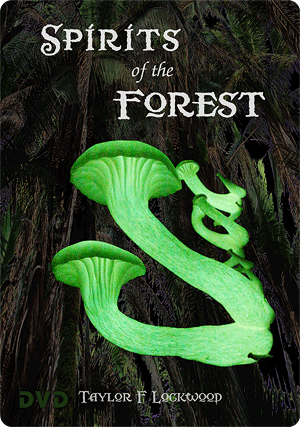
News & Stories / Mycology & Art News Bioluminescent Mushrooms from Spirits of the Forest Bioluminescent mushrooms and classical music from Taylor F. Lockwood. Yevgeny Nyden • November 22, 2013 Cover of Spirits of the Forest DVD (from mushroom.pro). Copyright 2016 Taylor F. Lockwood Enjoy this beautiful video of bioluminescent mushrooms accompanied by classical music, from Taylor Lockwood's "Spirits of the Forest" DVD. Members Only Content Login Join FFSC Related Posts Cam Cam by Taylor Lockwood Mycology & Art News Taylor Lockwood's National Geographic Magazine Debut Mycology & Art News Previous Article All News & Stories Next Article
- Myco Art | Fungus Federation of Santa Cruz
Mushrooms have sparked all sorts of creative works, leading to some fantastic art depicting mushrooms, and in some cases using mushrooms as part of the craft. Artists love to play around with the cool shapes, colors, and textures that mushrooms offer. Mushroom Photography Lentinus (Polyporus) arcularius. Photo by Cathy Welch Mushrooms are fun to photograph, due to their intricate details and variety of forms. They can also be challenging to capture when they grow in dark and/or hard-to-reach places--especially when your photography setup is minimal (to make room for carrying your collecting gear!). Photographers love to capture mushrooms from different points of view: Fruiting in habitat: Beauty shots, specimen studies, and quick snaps of mushrooms in forests, fields, and lawns show them off in their natural habitat. Browse our Mushroom Photo Gallery for some examples. Macro and microscopic photos: Close-ups that highlight the tiny details of mushroom caps, textures, spores and structures. We occasionally post examples on this website, such as in our free FFSC Online Learning programs, and you can browse the Web for thousands more! Life cycle changes: Some people document how mushrooms change through their life cycles, and/or how patches change across seasons. Check out this Time Lapsed Laetiporous article in our News section for an example. If you have an interesting life cycle series to share with us, let us know! Mushroom-Themed Art and Crafts If you're looking at this website, you might already have a few of these in your closet or cupboard or on your walls! Crafts: Some of us depect our favorite mushrooms in pottery and tiles, glass, clothing and jewelry, gift cards and stickers, wall hangings and more. Paintings: Artists paint mushrooms, depicting them in the wild or reimagined in abstract ways. Sculptures: Some talented folks craft mushrooms in 3D, using clay, wood, glass, or metal. Illustration : Check out the beautiful mushroom-themed illustrations we've commissioned for our Santa Cruz Fungus Fairs in our Fungus Fair Posters archive. Explore the works of local artisans in the vendor areas of the Santa Cruz Fungus Fair for some examples. Mushroom-Based Pigments Besides looking cool in artwork, mushrooms are also a wonderful source of natural pigments for creating art. Eco-Friendly Dyes: Mushroom dyes are a green alternative to synthetic ones, perfect for eco-conscious creators. Unique Color Palettes: Different kinds of mushrooms create a range of colors, from earthy browns to bright reds and yellows. Textile Techniques: Artists use various dyeing methods, like immersion or tie-dyeing, to create unique patterns and effects on fabrics. Browse our Arts menu for links to more information and some tips on how to get started with with mushroom dyes. Or visit the Craft Room at our annual Santa Cruz Fungus Fair and volunteers will show you how! (Or, if you already have experience with this art form, you can become a Fair volunteer and help others learn, too!) Craft room at the 47th FFSC Fungus Fair (2024). Photo by Hugh Smith Mushroom dyed silk at the 44th Fungus Fair. Photo by Hugh Smith (cropped) Myco Art Some people come for the food; some are driven by an interest in the science; and some come for the sheer beauty and/or bizarreness of certain mushrooms. If you're in the latter camp (or have toes in each), we have you covered!
- 24th Annual Wine & Mushroom Fest: Edible and Choice! | Fungus Federation of Santa Cruz
News & Stories / 24th Annual Wine & Mushroom Fest: Edible and Choice! The celebration is over and it was outstanding, with choice edibles abounding. The wild mushroom dishes prepared by the great cooks in our organization went far beyond my wildest dreams! Vernetta McGuire • March 1, 2006 Chocolate fountain at the 2006 Wine and Mushroom Dinner. Photo by Felicity Christenson You could never partake of these truly delicious and diverse dishes in any other place I could name. Attendance was about the same as in years past, despite a change of venue. Those who were unable to attend truly missed a sumptuous feast and an entertaining evening. Phyllis Cole in almost-full fungal regalia (minus her NAMA mushroom tiara) and Lee Yamada. Photo by Felicity Christenson We had many of the best wineries of the Santa Cruz Mountains Winery Association, thanks to Jeff Emery who coordinated this part of the fest. Silver Mountain, Clos Tita, Santa Cruz Mountain Vineyards, Osocalis, River Run, Thomas Fogarty and Ahlgren poured their best. Jeff puts the wine in the Wine and Mushroom and we couldn’t do it without him. The music by the Chanterelles was truly exceptional, adding a classical touch to our affair. Out in the woods. Photo by Felicity Christenson Then there was Bob Wynn, always on hand to dish out that wonderful appetizer he cooks along with the treats everyone else brings, from appetizers to desserts. Thanks so much to both of them. We had on the spot cooking of blinis by “King Henry”, served hot off the griddle with the assistance of his serving wench Marje. As always there was much enthusiasm; a line formed and it was certainly well worth the wait! Willie Wonka's Mushroom Wonderland at the 2006 Wine and Mushroom (by Deb Johnson and Phred Molnar). Photo by Felicity Christenson The dessert course was one of the best we’ve ever had. It was difficult to choose which one you wanted to partake of, as we had so many to choose from. Some included wild mushrooms in them, such as Candy Cap Crême Brulée and Candy Cap Cheesecake. Deb Johnson and Phred Molnar presented us with a completely edible forest log sprouting saprophytic chocolate mushrooms, surrounded with chocolate leaf duff and wax baggies of munchable mushrooms sitting in the duff. It was a feast for the eyes as well as the tongue. Then came the grand finale: a luscious and well-behaved chocolate fountain! Bridget Binko and Hensl Lise at the 2006 Wine & Mushroom Dinner. Photo by Felicity Christenson Special thanks go to the volunteers for your time and efforts in putting this event together and making it happen. We have such a great and fun group to work with! Each and every one of you made the 24th annual Wine and Mushroom event a delight to attend. Without all your help this could never happen. With my sincere appreciation, Vernetta McGuire, Culinary Minister Members Only Content Login Join FFSC Related Posts The Wine and Mushroom Experience was Phenomenal Previous Article All News & Stories Next Article
- What is Not to Love About The Prince? (Agaricus augustus) | Fungus Federation of Santa Cruz
What is Not to Love About The Prince? (Agaricus augustus) Just when you thought the mushroom season was over, “The Prince” may appear, providing mushroom enthusiasts a culinary bounty. Tall, stately, golden-hued and perfumed like almond paste, this royal-sized mushroom often fruits in warm weather. Coming upon the Prince unexpectedly can be an experience to remember. by Cortinarius, Katherine (Kitty) Elvin, Phil Carpenter and Beau Agaricus augustus. Photo by Drew Anderson (from mushroomobserver.org) Mature specimens are thick and meaty growing as broad as a dinner plate. So what is not to love about Agaricus augustus , commonly known as “The Prince”? FFSC members have some stories to tell about their encounters with this magnificent mushroom. Continue reading below for a summary of how to identify Agaricus augustus yourself. Encounters with The Prince Agaricus augustus . Photo by Tim Sage (from mushroomobserver.org) “I have picked lots of Agaricus augustus over the years, some very large, some small, but one episode stands out above the rest. A group of us travelled to Monterey to do a bike ride along the coast. We started our ride at the Asilomar conference center, where there is good parking and easy access to the coastal bike trail. I was quicker unloading my bike than the rest of the group so I jumped on and rode around a bit while waiting. Less than a block from our cars, I noticed an extremely large cluster of mushrooms along the side of the road. Upon inspection, it turned out to be a true cespitose cluster of "The Prince". That is a most unusual fruiting formation for that species. The individual mushrooms were all unopened buttons and each was at least as large as a softball. The whole cluster was about 2 feet across. I recall that there were 16 caps in the cluster while others recall even more. No matter what the count, everyone went home with a lot of tasty mushrooms to cook. As I recall, I fixed my share in a most yummy sauce that evening.” --Phil Agaricus augustus . Photo by V. Berthelsdorf (from mushroomobserver.org) “On May 27th, while hiking in the forests surrounding the Land of the Medicine Buddha Retreat Center, I spotted a group of A. augustus . I was quite surprised to find these delightful mushrooms just off a hiking trail, yet there they were, at the base of a small cliff, underneath large redwoods. The dry summer weather caught me unprepared; I generally carry specimen bags with me while looking for mushrooms, but as I was taking a relaxed hike and enjoying the quiet, I did not have anything to put them in. I left them beside the trail for someone else to enjoy...” --Beau Agaricus perobscurus . Photo by Susan Labiste “My first encounter with the Prince led to some gender confusion. Temperatures were in the 70s. It was steamy after a solid rain and a warming trend in March. There they were, deep in the forest near UCSC, all luminescent gold and rising from the shade in redwood duff and tanbark leaves. I gasped and my heart jumped. Could it be I had encountered “The Prince”? Who else could it be, so regal, so substantial, so golden, and in my hand so sweetly almond-scented. I gathered them greedily, gratefully and utterly besotted. But as this was a first encounter I decided to check this royal out with someone who knew it better than myself. It turned out that my “Prince” was a “Princess” ( A. perobscurus ). I was crestfallen… but in the pan my Princesses were every bit the culinary royal-equal to The Prince.” --Sue "Here are some photos of a Prince ( Agaricus augustus ) near my driveway. Shaggy stem but no bulb or rings near base. Also skirt-like veil still adhering a bit to outside edge. This one has very light colored gills for an Agaricus , though this is typical of this species when young. When spores mature they will be chocolate brown. Its sister mushroom was already dark gilled when I picked it the day before yesterday. Note the tawny fibrils. The ones I've seen have a lot of gold/yellow color. There is a fairly strong almond odor when cut. It smells heavenly. This specimen is fairly small for a Prince." --Kitty with Sue Morphology The first thing one notices when encountering a “Prince” is the size. Twenty-two centimeters (8.66") and larger in diameter is not uncommon. The cap is marshmallow-shaped before it is fully expanded, then becomes domed to flat or uplifted. The flesh is thick. The surface of the cap has many fibrillose scales, brown or golden-brown in color against a white background. It has a large, skirt-like annulus. The stem is often buried deep in the duff. Look for prominent raised fibrils below the annulus, giving a fluffy look to the stipe. The sweet scent of almonds should be discernable. When the cap is rubbed, it will slowly discolor to a golden yellow. (Please see pp. 337-338 in David Arora’s Mushrooms Demystified for a more complete list of characteristics.) Be sure your “Prince” has no cup or volva. The base should not be bulbous, nor should the base have ridge-like rings or signs of any universal veil remnants. Agaricus augustus . Photo by Christian Schwarz (from mushroomobserver.com) The Prince is a gilled mushroom. True to its genus, Agaricus , the mature gills are chocolate-brown as the spores mature. However, like most agarics, gill color in the button stage is pale. And "The Prince” is slow to change color. Though this mushroom is distinctive, it is possible to mistake a non-edible for this prize. When A. augustus is at its best for the table the gill color is still a buffy-white. This might cause some confusion, as many mushrooms, including some very toxic mushrooms , have white or nearly white gills. Be sure all identifying characteristics are present, and take your specimen to an expert for a back-up ID if this is a new species for you. Remember: When in doubt, throw it out! Avoid poisoning yourself or others. Mushrooms covered: Agaricus augustus (The Prince) Agaricus perobscurus (the princess) Previous Description All Featured Fungi Next Description
- CEO's Epistle to the Fungophiles: Whats Up | Fungus Federation of Santa Cruz
News & Stories / CEO's Epistle to the Fungophiles: Whats Up I hope March finds you happy, healthy, and imding mushrooms. Deb • March 1, 2000 Lactarius rubidus. © nosillaronnoc (CC-BY-NC) (from inaturalist.org, obs. 326521813) Locally we've been finding Craterellus , chanterelles and candy caps, upon which we all had the pleasure of feasting last night at Blacks Beach Cafe. Chef Robert Morris prepared a multiple dish tasting menu for about 55 FFSC'ers, "old" members and new, featuring wild mushrooms in various delicious guises. The evening was the brainchild of the Culinary Committee, superbly planned and brought about by Bob Wynn and Marjorie Young. We're hoping to make this an annual event - don't miss it again! Two more "don't miss" events coming up are the annual Wine & Mushroom Fest on Saturday, March 11 and the Continental Foray and Picnic on Sunday, April 16th. See details by Minister of Culinary Events Rene Seltzer inside and on the Events roster. If you're looking for general FFSC information or how to contact a minister for further info about classes, forays, etc., check out our website. Ford Johnson obtained the domain name and got us started, Kris Olsen did a wonderful job putting the site together, and we're at Cruzio with quicker loading speed thanks to Barbara Diamond and Mark Hanford. As always, the hotline is the most up to date source of information for local foray dates and times. An updated membership roster will be published with the Duff in the near future so you won't need to juggle all those Post-Its with names and phone numbers on them. Now get out there and find some mushrooms! Best of luck. Members Only Content Login Join FFSC Related Posts Previous Article All News & Stories Next Article
- Morel, the Magnificent Morel | Fungus Federation of Santa Cruz
Morel, the Magnificent Morel (2013). Photo by Hugh Smith Morel, the Magnificent Morel Hugh Smith This was one of only a few of this type of Morel that I found on this foray. I was in Lassen National Forest. It was a time when the State had no money to open all of the campgrounds. It was actually very late in the season for Morels, but there's always something to find. Morels in the Sierras like disturbed areas as well as burns. I went on a weekday. No one had begun to clean up the campgrounds where I was, and so it was a successful hunt... Camera Canon EOS REBEL T3i Focal L. 18mm Aperture f/13.0 Shutter Sp. 5s ISO 100 Flash Off Photo taken on May 22, 2013 Mushroom(s) ... Previous Photo Back to Gallery Next Photo