

.jpg)
Leccinum manzanitae. © Alan Rockefeller (from mushroomobserver.org)

Hannah Nadel is a research entomologist, currently with the USDA-Agricultural Research Service in Parlier, CA. She learned mushroom ID through the Los Angeles Mycological Society in the early 1980s while a graduate student at UC Riverside. While in Victoria, BC, Hannah helped found the South Vancouver Island Mycological Society. A tenderhearted soul, she felt bad about all the maggotty mushrooms being chucked out along the trailsides and decided to rear the larvae to the adult stage to identify what species prefer to breed in particular mushrooms. This led to maggoty piles deposited mysteriously on her doorstep after dark and to maggotty mushroom soup in jacket pockets many days after a stroll in the woods.
--Debbie Johnson
Editors' Note: This article was reprinted with permission from the August 1994 issue of Fungifama, the newsletter of the South Vancouver Island Mycological Society. The original article is still available as a PDF online, but we are reproducing it here in case that changes in the future. (We also added a few photos to this version.)
On a recent plant and insect collecting trip to the southern interior of British Colombia I noticed an interesting human behavior. Oluna Ceska, who seems sane enough, was patting Leccinum mushrooms. After beaming with delight as she spotted each of the rather sporadic Leccinums along the footpath through the woods, Oluna’s expression would change to one of hopeful apprehension as she stooped and patted the brownish cap. She then either picked the mushroom with a triumphant cry, or muttered sounds of disappointment and moved quickly on, her eyes sweeping the ground for further possibilities.
Efficient Foragers
When animals forage for food, they try to be as efficient as possible. Time is limited and they have much to do. They must find food, eat, wash, sleep, find mates, build nests, and produce and rear offspring within a limited lifetime. Spending too much time on one necessary activity may result in too little time spent on another, and the animal or its offspring could suffer. Clearly, the animal which spends the least amount of time deciding whether something is edible will have more time to spend looking for more food, and will, presumably, end up finding and eating more than a similar animal that spends a lot of time examining a potential tidbit to decide whether it is edible or not.
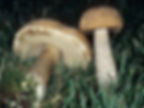
What Oluna was doing, I discovered, was minimizing the amount of time she spent deciding whether an edible mushroom was fit for the table or too riddled with worms to bother with (I’m assuming the technique works with mushrooms other than Leccinum). Rather than pick the mushroom, cut it open, and examine its flesh, she learned that a mushroom that feels firm to the touch is relatively worm-free, and that those that feel spongey or punky are riddled with worm burrows. She can test this with one or two quick pats. As well, Oluna had already reduced the amount of time she has to spend per trip deciding if a mushroom is edible, because she has learned to identify many edible species by sight and doesn’t pat the bad-tasting or poisonous ones.
But this story was not meant to be about time management in the life of a mushroom eater. Rather, it was meant to touch on the all-too-familiar “worms” that can turn a mushroom-eater’s delight to dolor, and a mushroom to, well, mush. Too often I get asked about what’s tunneling in a favorite edible, so I’ll give a brief account of what you might find in British Colombia.
Are they really worms?
First of all, like many things that are not what they seem to be, the worm-like creatures burrowing through your mushroom are not worms. They are insects. More specifically, they are the young of flies or, sometimes, beetles. Insects start their lives as eggs that hatch into larvae, and some, such as flies and beetles, undergo a resting stage, or pupa, before turning into winged adults (others change from larvae directly to adults). All growth occurs during the larval stage, and it’s therefore no surprise that this stage is the most voracious. These eating machines enlarge and fatten, and periodically shed their skin as they outgrow it, finally moulting into a resting pupal stage during which they metamorphose into winged adults. After escaping from the pupal skin, the adults may or may not feed, depending on the species, and they do not shed their skin again. They don’t grow, although the females may expand tremendously while carrying eggs.

In B.C., the most common fly larvae, or maggots, that you’ll find feeding in mushrooms belong to the fungus gnat family, the Mycetophilidae (pronounced my-see-toe-fill-id-ee, from the Greek words for fungus — mykes, and lover — philea). They are not too hard to distinguish from other maggots in mushrooms because they have very dark heads and strong constrictions along their pale bodies. Like many other maggots, they are soft and thin-skinned, which makes them vulnerable to drying. Living inside a moist mushroom, or, in other cases, in rotting vegetation, protects them from drying and provides them with plenty of fungal tissue to feast on. The eggs are laid directly on the mushroom, usually on the underside in the spaces between the gills or in the pores (depending on what the mushroom has), and within a day or two the tiny, hatchlings begin feeding on these structures. At this stage the mushroom is still perfectly edible and the cap is firm.

As they grow, the legless larvae burrow into the flesh of the stem and cap and literally eat themselves out of house and home. The burrows fill with digestive wastes and can be invaded by bacteria and other fungi; they generally appear rather brown or yellowish, and shouldn’t be eaten. If you find a mushroom with burrows in the stem only, it is quite safe to simply discard the stem and cook up the cap. By my standards, a few tunnels in the cap won’t hurt you either, but my gag threshold is perhaps higher than yours.
When ready to pupate, after a week or so, fungus gnat larvae usually leave the rubble of the mushroom and pupate in the soil below it. After a few more days the dark, mosquito-like adults emerge, mate, and the females smell their way to a new mushroom on which to lay eggs. They usually prefer young mushrooms, perhaps because these will last longer and also probably because they’re racing against other fungus gnats (and/or other insects) to provide their own offspring with the advantage of being the first on a limited island of food.
Miscellaneous Maggots
Other maggots you might encounter in a mushroom are the smoother-bodied and pale-headed relatives of the small flies that visit your fruit bowl at home and feature in your genetics class at school. This family of fly is the Drosophilidae (pronounced dro-soh-fill-id-ee, from the Greek words for dew or sap — drosos, and lover — phileo), also known as pomace flies or even as fruit flies, although they mustn’t be confused with the true fruit flies (family Tephritidae).
Larvae of pomace flies feed on fungi in rotting vegetation, fruit, sap flows on trees, or directly in mushrooms. Their life cycles resemble those of fungus gnats, so I won’t dwell on them further. The adults are quite different from the fungus gnats, being shaped more like a common housefly, but much smaller and usually colored a shiny honey-brown. Those of you who have studied genetics in school will remember the famous “fruit fly”, Drosophila melanogaster, the laboratory rat of the insect world, whose giant salivary-gland chromosomes and rapid reproduction have made it the darling of geneticists. The larvae of this species feed on fungi in rotting fruits. The adults carry fungi or spores on their feet to inoculate ripe, newly-bruised fruit on which they will lay their eggs.
Many other families of flies feed at least partly on fungi, some on mushrooms, but most often on fungi that cause decay in plant material or dung. The dark-winged fungus gnats, family Sciaridae (sce-ar-i-dee), from the Greek skieros -shady, because they like shade), are often reported as pests in commercial mushroom houses. They also feed on fungi in decaying plant material such as rotting moss, which is why you might see hordes of them around your overwatered potted plants at home and in greenhouses. They are also rather mosquito-like, delicate and often minute, with dark gray wings.
Be sure to count the legs on your maggot, it may really be a baby beetle
Like flies, many families of beetles also feed on fungi. Some of them are very beautiful, as is reflected in names like "handsome fungus beetles" and "pleasing fungus beetles." Some feed on mushrooms, but many can handle the tougher woody bracket fungi and other polypores.
Unlike flies, the adults often feed on the same stuff as their larvae, and these two stages can be found together in one mushroom. Adult beetles are generally hard-bodied, with a pair of hard outer wings that fit closely over the back like a shell (the soft, transparent flight wings are folded under these protective wings and are not usually visible). The larvae are often wormlike, but, unlike maggots, they have three pairs of legs on the underside just behind the head, and the head is hard, usually brown, and armed with visible teeth (use your magnifying glass!). The pupa may be in the fungus or outside, depending on the beetle species. The life cycle of beetles is generally much longer than that of flies, but some can develop from egg to pupa during the short life of a soft mushroom.

In British Colombia you might, through diligent search, find beetles of at least ten families in soft mushrooms and in the harder brackets or other fruiting bodies. Many are rare. The showiest are the handsome fungus beetles (family Endomychidae, pronounced en-doe-my-kid-ee, from the Greek endon - within, and mychos -innermost recess; the meaning escapes me), and the pleasing fungus beetles (family Erotylidae, pronounced air-o-till-id-ee, for which I can’t find any word origins that make any sense at all!). These striking beetles are shiny, and patterned black with a mix of red, orange, and/or yellow. The handsome fungus beetles are usually smaller but can reach 1 cm. in length, about half the size of pleasing fungus beetles.
If your mushroom has a drab beetle up to 1⁄2 cm in length, with spiny-looking margins on its “neck”, it’s probably a tooth-necked fungus beetle (family Derodontidae, pronounced dare-oh-don-tid-ee, from the Greek deros-skin, and odontos- tooth).
A long, slender, flexible beetle with short outer wings would be a rove beetle (family Staphylinidae, pronounced staff-ill-in-id-ee, from the Greek staphylinos - an insect), usually found among the gills rather than in the flesh of the mushroom.
Other families include an array of small, drab beetles fondly known as LBJs(Little Brown Jobs, just like the LBJs we love to ignore in the mushroom world). Some tooth-necked fungus beetles and round fungus beetles (which can curl into a ball) feed on slime molds. There’s no accounting for taste.
Wasps - the Calculating Females
Now we know more or less who in the insect world is eating our mushrooms. But it’s not enough that our delicacies are full of flies and beetles, they have a variety of minute wasps, too!

These, however, are not joining the feast; rather, they are parasitizing and killing the fungus eaters. They are the good gals, the natural controlling agents that help keep the world from turning into one huge, wriggling, buzzing mass of insects. These tiny wasps, usually 1-4 mm long, do not sting and have no interest at all in humans. We, however, should he kissing the ground under each of their six little feet! Wasps that parasitize mushroom eaters usually find mushrooms by smell, after which they search for eggs, larvae, or pupae of flies or beetles either by feel, vibrations, or again by smell. The females have a long, hollow, threadlike structure on their rear end through which eggs are laid on the victim (host) or inside it. The eggs hatch and the wasp larvae feed on the host insect, eventually killing it. The wasp larvae then pupate before turning into delicate, wasp-waisted adults. You might find the wasps as unsavory as the other insects in your mushroom, but remember that by killing many of the flies and beetles, the wasps prevent them from multiplying without check and infesting every single fungus on Earth. Also, they don’t harm uninfested fungi. There are several families of parasitic wasps saving our mushrooms, and millions of species that parasitize and kill insects in our homes, gardens, fields, forests, and water.
Soon, when the rain comes back, it will be time to go out and pat the mushrooms. But just remember that while most of you are leaving punky mushrooms alone, at least one deranged individual will be maximizing the number of interesting fungus-caring insects she collects by following you and picking precisely those mushrooms which you’ve patted and left behind. There’s no accounting for taste, is there?
Hannah Nadel