Search this site
645 results found with an empty search
- FFSC Terms of Use | Fungus Federation of Santa Cruz
Support The following Terms of Use govern all use of text, photography, videos, artwork, audio, and downloadable files (such as but not limited to .pdf, .ppt, .xls, .xlsx, .rtf, .doc, .txt, and any downloadable graphics or video files) (collectively, the "Content"); classes/workshops, forays, culinary events, talks, online forms, and online educational resources and programs (collectively, the "Services"); and T-shirts, posters, stickers and other physical goods (collectively, the "Products") which are available at or through the websites, social media channels, ticketing services and related systems (collectively, the "Platform") which the Fungus Federation of Santa Cruz ("FFSC") manages and uses for club operations. The Platform is offered subject to Your acceptance without modification of all the terms and conditions contained herein and all other operating rules, policies (including, without limitation, the Privacy Policy and FFSC Bylaws ) and procedures that may be published from time to time on this site by FFSC (collectively, the "Agreement"). Please read this Agreement carefully before accessing or using the Platform. By accessing or using any part of the Platform, each user or internet bot ("You", "Your" or "User") agrees to the terms and conditions of this Agreement. If You do not agree to all the terms and conditions of this Agreement, You should not access the Platform or use any Services or Products made available via the Platform. (1) Your FFSC Account If you create an account on the Platform, You are responsible for maintaining the security of Your account, and You are fully responsible for all activities that occur under the account and any other actions taken in connection with the account. You must not post content to Your account in a misleading or unlawful manner, including in a manner intended to trade on the name or reputation of others. FFSC may, at its discretion, change or remove any content that it considers inappropriate or unlawful. Please immediately notify FFSC of any unauthorized uses of Your account or any other breaches of security. FFSC will not be liable for any acts or omissions by You, including any damages of any kind incurred as a result of such acts or omissions. (2) Responsibility of Contributors If You post Content to the Platform, or otherwise make (or allow any third party to make) Content available by means of the Platform, You are entirely responsible for the content of, and any harm resulting from Your use of, that Content. That is the case regardless of whether the Content in question constitutes text, graphics, an audio file, or computer software. If you created or owned the Content prior to contributing the Content to the Site, and that Content is subject to Intellectual Property rights, you retain ownership of those rights. Unless you specify otherwise when you post Content, you agree to license Content you contribute to the Platform under the Creative Commons Attribution Noncommercial license ( CC BY-NC ). If You post Content created or owned by someone else and that Content is subject to Intellectual Property rights, You are responsible for verifying that the original owner has granted You permission to use their creative work to the Platform and that you adhere to the license provided by that Content owner under copyright law. By making Content available, You represent and warrant that: the Content does not contain or install any viruses, worms, malware, Trojan horses or other harmful or destructive content; the Content is not spam and does not contain unethical or unwanted commercial content designed to drive traffic to third party sites or boost the search engine rankings of third party sites, or to further unlawful acts (such as phishing) or mislead recipients as to the source of the material (such as spoofing); You will post only Content that is relevant to FFSC and its Mission , and at a rate and volume that does not hinder other Users' ability to use the Platform; the Content is not libelous or defamatory, does not contain threats or incite violence towards individuals or entities, and does not violate the privacy or publicity rights of any third party; Your account details do not mislead others into thinking they represent another specific person or organization (unique pseudonyms are allowed). For example, Your login name is not the name of a person other than Yourself or organization other than Your own; Your content is not getting advertised via unwanted electronic messages such as spam links on newsgroups, email lists, journals and web sites, and similar unsolicited promotional methods. By submitting Content for inclusion on the Platform, You grant FFSC a world-wide, royalty-free, and non-exclusive license to reproduce, modify, adapt, and publish the Content solely for the purpose of displaying, distributing, and promoting Your Content via the Platform, and for the purpose of displaying or promoting the Content or FFSC itself in other venues, such as social media or software distribution platforms. We may repackage publicly available information associated with the Content in a machine-readable format for a handful of other parties, including the Santa Cruz Museum of Natural History and others. You represent and warrant that (a) You own and control all of the rights to the Content that You post or You otherwise have the right to post such Content to the Site; (b) the Content is accurate and not misleading; and (c) use and posting of the Content You supply does not violate this Agreement and will not violate any rights of or cause injury to any person or entity. If You delete Content, FFSC will use reasonable efforts to remove it from the Platform, but You acknowledge that caching or references to the Content may not be made unavailable immediately. Without limiting any of those representations or warranties, FFSC has the right (though not the obligation), in FFSC’s sole discretion, to terminate or deny access to and use of the Platform to any individual or entity for any reason. (3) Responsibility of Website Visitors FFSC is a volunteer-run organization. While our website volunteers and advisors do their best to review Content when it is initially posted to the Platform and to periodically revisit and update the Content, FFSC volunteers cannot review all of the Content, and therefore cannot be responsible for that Content, use or effects. By operating the Platform, FFSC does not represent or imply that it endorses the material posted to the Platform, or that it believes such material to be accurate, useful, non-infringing or non-harmful. You are responsible for taking precautions as necessary to protect Yourself and Your computer systems from viruses, worms, Trojan horses, and other harmful or destructive content. The Platform may contain content that is offensive, indecent, or otherwise objectionable, as well as content containing technical inaccuracies, typographical mistakes, and other errors. The Platform may also contain material that violates the privacy or publicity rights, or infringes the intellectual property and other proprietary rights, of third parties, or the downloading, copying or use of which is subject to additional terms and conditions, stated or unstated. FFSC disclaims any responsibility for any harm resulting from the use by visitors of the Platform, any mislabeling by Platform visitors of observations, or from any downloading by those visitors of content posted to the Platform. (4) Inappropriate Use You agree not to use the FFSC Platform, Services, or any Content for any illegal, unlawful, or unauthorized purpose or activity, including but not limited to threatening, abusing, soliciting, spam, harassing, stalking, impersonating, or intimidating other FFSC or Platform Users. (5) Copyright Infringement FFSC respects the intellectual property rights of others, and requests that Users of the FFSC Platform, Services and Content do the same. FFSC does not own the Content that FFSC members and guests (collectively, "Contributors") post here, the Content belongs to the people who created or legally own the Content. Any Content posted to the Platform (including but not limited to this website, the FFSC public Facebook Group, the FFSC Google Group, the FFSC YouTube channel, and other FFSC-managed media channels) may be displayed on other parts of the Platform without notice. FFSC volunteers will do their best to credit the owner of the Content when made aware of such uses. Due to the technical operations and limitations of each online system and/or subsystem, ownership credits might appear directly below the Content, or only when hovering over the Content, or it might be cited at the bottom of the page. Some Contributors to this Platform post Content (such as photographs and recipes) from third-party websites and systems. Such Content is copyrighted by the original creators, and is included on this Platform for non-profit, non-commercial educational purposes only. Please do not download or reprint such third-party Content directly from the FFSC Platform. If you are interested in using any creative works sourced from the NAMA website, see Copying material from the NAMA website . If you are interested in using any creative works sourced from Mushroom Observer, see the License section of "How to Use Mushroom Observer". If you are interested in using any creative works sourced from MykoWeb, see Use of Photographs at MykoWeb . If you are interested in using any creative works sourced from iNaturalist, see Can I use the photos and sounds that are posted on iNaturalist ? If you are interested in using any creative works sourced from other sources, please visit those sources for usage information. If You believe that Your work has been copied on the Platform in a way that constitutes copyright infringement, please reach out to FFSC by using the Contact Us form on the Contact FFSC page. FFSC volunteers will respond to all such notices, including as required or appropriate by removing the infringing material or disabling all links to the infringing material (also see below). In the case of a visitor who may infringe or repeatedly infringes the copyrights or other intellectual property rights of FFSC or others, FFSC may, in its discretion, terminate or deny access to and use of the Platform. (6) Intellectual Property All trademarks, service marks, graphics and logos used in connection with FFSC or the Platform are trademarks or registered trademarks of the Fungus Federation of Santa Cruz or the Platform's Users or other third parties. Your use of the Platform grants You no right or license to reproduce or otherwise use any FFSC or third-party trademarks for any purposes. This Agreement does not transfer to You any FFSC or third party intellectual property, and all right, title and interest in and to such property will remain solely with FFSC or such owners. (7) Prohibited Use for Commercial AI Training Users may not use any data on the Platform for training artificial intelligence, machine learning models, large language models, or similar networks, algorithms, or systems for commercial purposes. (8) Changes to the Agreement FFSC reserves the right, at its sole discretion, to modify or replace any part of this Agreement. It is Your responsbility to check this Agreement periodically for changes. Your continued use of or access to the Platform following the posting of any changes to this Agreement constitutes acceptance of those changes. FFSC may also, in the future, offer new Services and/or features through the Platform (including, the release of new tools and resources). Such new features and/or Services shall be subject to the terms and conditions of this Agreement. (9) Termination of Your Access FFSC may terminate Your access to all or any part of the Platform or Services at any time, with or without cause, with or without notice, effective immediately. If You wish to terminate this Agreement or Your FFSC account, You may simply discontinue using the Platform and cancel Your FFSC Membership. If you wish to completely delete Your Account on ffsc.us , please use the Contact Us form on the Contact FFSC page and choose "FFSC Website issue" as the Topic Area. All provisions of this Agreement which by their nature should survive termination shall survive termination, including, without limitation, ownership provisions, warranty disclaimers, indemnity, and limitations of liability. (10) Disclaimer of Warranties The Platform is provided “as is.” FFSC and its suppliers, partners and Members hereby disclaim all warranties of any kind, express or implied, including, without limitation, the warranties of merchantability, fitness for a particular purpose and non-infringement. Neither FFSC nor its suppliers, partners or Members makes any warranty that the Platform will be error free or that access thereto will be continuous or uninterrupted. You understand that You download from, or otherwise obtain Content, Services or Products through, the Platform at Your own discretion and risk. (11) Limitation of Liability In no event will FFSC be liable with respect to any subject matter of this Agreement under any contract, negligence, strict liability or other legal or equitable theory for: (i) any special, incidental or consequential damages; (ii) the cost of procurement or substitute products or services; or (iii) for interruption of use or loss or corruption of data. FFSC shall have no liability for any failure or delay due to matters beyond its reasonable control. The foregoing shall not apply to the extent prohibited by applicable law. (12) General Representation and Warranty You represent and warrant that (i) Your use of the Platform will be in strict accordance with the FFSC Privacy Policy , with this Agreement and with all applicable laws and regulations (including without limitation any local laws or regulations in Your country, state, city, or other governmental area, regarding online conduct and acceptable content, and including all applicable laws regarding the transmission of technical data exported from the United States or the country in which You reside) and (ii) Your use of the Platform will not infringe or misappropriate the intellectual property rights of any third party. (13) Indemnification You agree to indemnify and hold harmless FFSC, its contractors, partners, licensors and Members, and their respective directors, officers, employees, partners and agents from and against any and all claims and expenses, including attorneys’ fees, arising out of Your use of the Platform, including but not limited to Your violation this Agreement. (14) Platform Code You agree to indemnify and hold harmless FFSC, its code contributors, its its contractors, partners, licensors and Members, and their respective directors, officers, employees and agents from and against any and all claims and expenses, including attorneys’ fees, arising out of publishing or using Platform code or the acceptance of code contributions from outside parties. (15) Miscellaneous This Agreement constitutes the entire agreement between FFSC and You concerning the subject matter hereof, and may be modified only by a written amendment signed by an authorized executive of FFSC or by the posting by FFSC of a revised version of these Terms of Use. Except to the extent applicable law, if any, provides otherwise, any access to or use of the Platform will be governed by the laws of the state of California, U.S.A., excluding its conflict of law provisions, and the proper venue for any disputes arising out of or relating to any of the same will be the state and federal courts located within 60 miles of Santa Cruz, California. The prevailing party in any action or proceeding to enforce this Agreement shall be entitled to costs and attorneys’ fees. If any part of this Agreement is held invalid or unenforceable, that part will be construed to reflect the parties’ original intent, and the remaining portions will remain in full force and effect. A waiver by either party of any term or condition of this Agreement or any breach thereof, in any one instance, will not waive such term or condition or any subsequent breach thereof. You may not assign Your rights under this Agreement; FFSC may assign its rights under this Agreement without condition. This Agreement will be binding upon and will inure (take effect) to the benefit of the parties, their successors and permitted assigns. Supplemental Information Copyright Concerns & Questions FFSC's ability to adhere to copyright credits and/or infringement notices may vary over time due to these factors: FFSC is a nonprofit club operated by a rotating group of volunteers with a diverse range of skills. Some volunteers who contribute Content to this website might not be able to consistently follow FFSC's standards and processes. FFSC might not have other volunteers available with the right skills or availability to identify and update such Content within Your sense of a timely manner. If you notice that a credit is missing, or a copyright request you submitted has not yet been fulfilled, please try contacting us through any of the means provided on the Contact FFSC page. FFSC uses applications and systems that belong to external platforms (ticketing, shopping, video, etc.) which own and manage their own user interfaces, including the number of characters available for captions and other text. This means FFSC volunteers must provide copyright credits by using the options those systems offer. Therefore, FFSC volunteers must sometimes shorten attributions and credits; and such attributions and credits may be placed in different locations relative to the Content. FFSC has existed for over 40 years, and has operated at least 4 versions of this website on different hosting systems since 2001, as well as online and physical newsletters for many years before that time. This means some of the Content shown today might have been obtained from other sites (such as mushroomobserver.org ) many years ago, and might not contain copyright statements that are included on or with newer versions of those works. If You own a photograph or other creative work which appears to be missing such information, we would appreciate it if you would provide (or share a link to) the latest version of that work, and our volunteers will do their best to replace the older version. Payment Methods FFSC uses PayPal for payment processing on this Platform, and may also use Square for certain events and purchases. FFSC reserves the right to change our payment method choices in the future. For more information about why we use PayPal, visit the Membership FAQ on our Why Join FFSC? page. Returns, Refunds, and Warranties Refunds are determined differently for each event. Before purchasing tickets to any event, please read that event's policies carefully. T-shirts, stickers, or other physical items that you purchase directly from FFSC are generally considered non-refundable, unless otherwise specified. For items sold through third-party vendors, see that vendor's return, refund, and/or warranty policies. Products we sell online are generally non-refundable unless we specify a particular return or refund policy for a specific product. FFSC Terms of Use This website is managed by the Fungus Federation of Santa Cruz , an independent 501(c)(3) nonprofit based in the state of California in the United States of Amercia (EIN 77-0085878).
- Lawn Agaricus | Fungus Federation of Santa Cruz
Lawn Agaricus This featured species turns up in the plastic bags of people attending the Fungus Fair perhaps more than any other fleshy fungus. Invariably, hordes of people will be lined up at the mushroom ID table with bags containing fresh to soggy specimens of Agaricus mushrooms they found “growing in my lawn. Are these edible? Will they poison my dog, cat, kids?” by Bob Sellers Agaricus californicus. Photo by Noah Siegel (from mushroomobserver.org) Indeed, when abundant, lawn Agaricus probably elicit more questions for identification than any other species. They are obtrusively obvious, boldly bursting up through a lush carpet of green grass. People don’t have to venture very far to collect them. They are also exceedingly common, appearing shortly after the first fall rains before the weather gets too cold, even in the summer in well-watered lawns. Cemeteries contain them, city parks can produce them, and along with fairy ring mushrooms, they are the most abundant large mushrooms of lawns and mowed grassy areas. Agaricus californicus . Photo by Debbie Viess (from mushroomobserver.org) Agaricus species are an easy group to recognize because of the store-bought variety with which everyone is familiar. When mature, all Agaricus species have dark brown gills which give a chocolate brown spore print. The stem will separate cleanly from the cap and gills, and the stem (stipe) will also have a ring or annulus, which may be thick and persistent or may collapse as the mushroom matures. The cap color is generally white, but there can be gray to brown patches or fibrils on the cap depending on the species and age. These features will help you determine if your mushroom is an Agaricus , but knowing which Agaricus you have will take a closer look. Agaricus xanthodermus . Photo by Shane (from mushroomobserver.org) Pull your mushroom out of the ground so that your get the entire stem. Clean off some dirt and scratch the very bottom of the stem with a fingernail to remove some mushroom tissue. Did the scratched area immediately stain bright yellow? If it did you have A. xanthodermus , which means yellow skin. (Other parts of the stem and cap may also stain yellow from handling. The base of the stem, however, is the critical part.) This mushroom often grows in large clusters or fairy rings, and also under cypress and oak trees. The color of the entire mushroom is nearly white, but it often develops grayish to brownish or even metallic tones on the cap with age. The ring is thick and membranous with flat patches underneath. Crush the mushroom and notice the strong odor of phenol (medicinal odor) that exists along with the “normal” mushroomy scent. All of the phenol-smelling Agaricus species actually contain the compound phenol and are considered poisonous, although I’ve heard of individuals who don’t seem to be affected (i.e., vomit) after eating these species. Agaricus arvensis . Photo by Herbert Baker (from mushroomobserver.org) If the base of your lawn Agaricus didn’t stain yellow but there are yellow stains from handling on the cap or stalk, take another sniff and see if you can detect the odor of anise or almond extract. If this odor is present, your mushroom is most likely A. arvensis , the horse mushroom, so named because of the musty or urine-like odor the mushroom develops when old. Also found in pastures along with A. osecanus (the giant horse mushroom), A. arvensis has a nearly pure white cap and stalk and is a look-alike for A. xanthodermus , but doesn’t grow in clumps nor have a phenol odor. The annulus is persistent, thick and cottony with tooth-like patches on the underside. Agaricus arvensis . Photo by Walter Sturgeon (from mushroomobserver.org) A. arvensis is a choice edible (as are all the anise or almond smelling Agaricus species). Sliced and dried, it maintains its anise odor and lends a marvelous flavor to soups. You can eat it fresh or stuff the caps with chopped stems, onions, basil, parmesan cheese and broil. Agaricus californicus . Photo by Noah Siegel (from mushroomobserver.org) The next two lawn Agaricus are difficult to tell apart unless you have a good nose and some young buttons of each species. If your mushroom doesn’t stain visibly yellow from handling, lacks and anise odor, but has a faint phenol odor, you probably have A. californicus . The odor is not as apparent as in A. xanthodermus , but it is there — especially in young specimens that haven’t become waterlogged or rotten. This species seems to be especially abundant in Santa Cruz and most often in lawns, rarely in pastures. It will also appear in disturbed ground, roadsides, vacant lots or in grassy areas along the edges of the woods. When mature, this species has a flattened top which has brown, gray or even silvery areas in the center of the cap. It is often gregarious, growing in patches, but not in rings. The membranous ring in A. californicus has felt-like patches on the underside and will be evident even as the mushroom ages. As with A. xanthodermus , the phenol odor in A. californicus , often faint or difficult to detect, should dissuade you from eating it. However, some people do just fine and actually enjoy this very common Agaricus . Agaricus campestris . Photo by Darvin DeShazer (from mushroomobserver.org) The final lawn Agaricus we’ll mention is the meadow mushroom, A. campestris . As its name suggest, this species is usually found in meadows or pastures, but it occasionally strays into some fortunate person’s lawn. The meadow mushroom is easy to identify in the button stage, for it is the only local Agaricus with pink gills when it is young (before the cap opens). As it matures, the pink color fades until the gills are brown as in all Agaricus . There is no phenol odor, only a lovely sweet mushroom scent. No part of the mushroom stains yellow, but red stains may appear when the mushroom is wet. The color is nearly all white, bur in age darker areas may appear near the center of the cap. The veil is thin, cottony and collapses or disappears entirely as the gills open from the button stage. The stalk is rather short and often tapers towards the base. This mushroom is far superior in flavor to the store-bought variety, and can be used in any recipe calling fresh mushrooms. One final note: please be absolutely sure of your identifications before making a meal of your lawn Agaricus . Use all of your senses and consult a more thorough description in a guidebook if you are not entirely convinced which species you might have; or consult with a mushroom ID expert. I have tried to describe the most common Agaricus species you will encounter. There are others than can occur occasionally in lawns. However, Agaricus is a rather “safe” genus in that no species are deadly, and all of the poisonous species have a phenol odor, which is most notable in fresh younger specimens. Mushrooms covered: Agaricus arvensis (horse mushroom) Agaricus californicus (mock meadow mushroom) Agaricus campestris (lawn mushroom, meadow mushroom, field mushroom) Agaricus xanthodermus (yellow stainer) Previous Description All Featured Fungi Next Description
- Meet Amanita pruittii: Arora’s Amanita, Anonymous No More! | Fungus Federation of Santa Cruz
Meet Amanita pruittii: Arora’s Amanita, Anonymous No More! Those of us who are passionate about all aspects of wild mushrooms are a breed apart. As mycophilic outliers to the societal norm, what better focus for our discerning attention than a mycological oddity like the renamed Amanita pruittii ? This mushroom is unimposing, squat and warted, sometimes grows in standing water, and most curiously, is not found with a mycorrhizal partner! by Debbie Viess Amanita pruittii fruiting in a damp field. Photo by Taylor Lockwood (from mushroomobserver.org) What kind of strange Amanita is this??! Amanita pruittii . Photo by Taylor Lockwood (from mushroomobserver.org) David Arora was apparently the first Western mycologist to find and document this amanita in the Santa Cruz area in the early 1970s. He wrote about it in his classic field guide, Mushrooms Demystified , referring to it as the “Anonymous Amanita.” Although he sent collections of this unknown species to Dr. Alexander Smith in Michigan for further mycological analysis, those specimens were apparently never received. A few years later, Ben Pruitt, an 88 year old, keen-eyed naturalist and amateur mycologist in Oregon, discovered a huge fruiting of hundreds of these amanitas, in a flooded field at Fern Ridge Reservoir in the Willamette Valley, a protected Oregon State Wildlife Area as well as an Army Corps of Engineers Research Natural Area. He suspected that they might be some sort of Armillaria species, and also sent his collections to Dr. Smith. Smith determined that they were an unknown species of amanita and proposed naming them after Pruitt. But Smith never described the species. When I attended my very first NAMA foray in 2002 at Diamond Lake, Oregon, I mentioned my ongoing interest in amanitas to other attendees. Local mycologists couldn’t wait to tell me all about a curious amanita that had recently fruited in great numbers at Fern Ridge … without a host tree in sight! This 2002 fruiting, as well as one in 1998, both of which followed prescribed burns, were apparently the first major fruitings of this non-mycorrhizal amanita since the original finds by Ben Pruitt in 1975. My interest was certainly piqued, but the local fruiting was over, and Oregon a long way from home. Fast forward to Menlo Park, San Mateo County, CA in 2007, when FFSC member Doug Smith found what appeared to be an A. pruittii in a treeless field. Other FFSC members started to look hard for this curious mushroom, and Christian Schwarz was rewarded with a Santa Cruz sighting in 2011. Amanita pruittii. Photo by Christian Schwarz (from mushroomobserver.org) Amanita pruittii (top view). Photo by Christian Schwarz (from mushroomobserver.org) 2014 was a banner year for this amanita across its range. Starting our local spate of sightings, Adam Ryzka found a solitary fruit body along a Santa Cruz city street in September 2014, followed by several observers finding it from Marshall Fields to Watsonville to West Cotati through November 2014. The most spectacular Amanita pruittii finds of 2014 were again found at Fern Ridge Reservoir during the month of October. Hundreds of fruit bodies poked their caps above standing water, in a prairie floodplain that had been burned several months prior. Taylor Lockwood obtained many wonderful photos of this phenomenon. All of these A. pruittii observations can be seen on Mushroomobserver.org. In the Pacific Northwest, Jan Lindgren is the go-to gal for all things amanita, and she received from the late Kit Scates Barnhart the original correspondence between Ben Pruitt and Alexander Smith on Amanita pruittii . The official naming of this species was a work in progress for Jan and Rod Tulloss for decades, while other projects took precedence. In October 2014, the name Amanita pruittii was at long last published in the online journal “Amanitaceae.” Its title: “Amanita pruittii, a new, apparently saprotrophic species from US Pacific coastal states,” authored by Rodham Tulloss, Janet Lindgren, David Arora, Benjamin Wolfe and Cristina Rodriguez-Caycedo. Other than its peculiar fruiting habits, this is a rather unprepossessing mushroom, with a dirty white cap, a squat form, and a universal veil (UV) that breaks into warts on the cap, and forms fibrils or squamules on the pointed stipe; all of these UV elements can disappear with age. Amanita pruittii often discolors brown or reddish with age, especially when growing in wet conditions. Like all amanitas, A. pruittii has whitish gills and white spores in mass, and like other members of Amanita section Lepidella , those spores turn blue upon the application of the iodine-based Melzer’s solution. Pruittii can have a variety of odors, from indistinct to earthy, potatoes to brine, and becomes unpleasant smelling in age. Its taste is not distinctive when raw, but is bitter and unpleasant when cooked. Despite this, Ben Pruitt tried four slices from his original collections, and reported no adverse effects. However, eating any member of section Lepidella is not recommended, since this group is often difficult to identify down to exact species, and contains seriously toxic species like Amanita smithiana . Amanita pruittii fruiting in a flooded field. Photo by Taylor Lockwood (from mushroomobserver.org) Heads-up, California and PNW mushroom hunters! Keep your keen eyes peeled for more fruitings of this very curious amanita. It can grow singly or gregariously, and under the right conditions, by the hundreds, especially following a burn. Look for it in lawns, wet meadows and pastures, with poor, exposed soils and even in street tree wells! It most commonly fruits in the fall months, but can also fruit into March and as late as June in irrigated landscapes. It sometimes grows alongside various species of Agaricus , and can be mistaken for that genus. When you next see a “commonplace” field of white mushrooms, assume nothing and check those gills! Who knows, you might be the next lucky person to find this very curious, non-mycorrhizal amanita, Amanita pruittii : Arora’s “Anonymous Amanita” no longer! Debbie Viess aka Amanitarita Mushrooms covered: Amanita pruittii Previous Description All Featured Fungi Next Description
- Strobilurus trullisatus | Fungus Federation of Santa Cruz
Strobilurus trullisatus. 2013, Fort Bragg. Photo by Hugh Smith Strobilurus trullisatus Hugh Smith Strobilurus trullisatus forms colonies on old Douglas fir cones. Thank you, Hugh, for this lovely photograph! Camera (Not provided) Focal L. Aperture Shutter Sp. ISO Flash Photo taken on January 19, 2015 Mushroom(s) ... Previous Photo Back to Gallery Next Photo
- Auriscalpium vulgare on Pinecone | Fungus Federation of Santa Cruz
Auriscalpium vulgare (Soquel, 2016). Photo by Cass Fuentes Auriscalpium vulgare on Pinecone Cass Fuentes Exploring the Soquel Demonstration Forest at the FFSC local foray in February, and though the weather was amazing, the fleshy fungi were few and far between... None-the-less, there was some really cool finds, including Hericium coralloides (a choice edible related to Lion's Mane), and Auriscalpium vulgare . Camera (Not provided) Focal L. Aperture Shutter Sp. ISO Flash Photo taken on February 20, 2016 Mushroom(s) ... Previous Photo Back to Gallery Next Photo
- Inky Caps - from "Basic Inky Cap ID for California" | Fungus Federation of Santa Cruz
Inky Caps - from "Basic Inky Cap ID for California" "Out of the millions of different kinds of fungi out there, I think that inky caps are the coolest by far. They are called inky caps because they dissolve into black ink when they get old. They are also often misidentified, so I put together a list of the common inky caps and their differences." by Peter Vahlberg Coprinopsis lagopus gr. Photo by Terry Way Editors note: FFSC member Peter Vahlberg posted "Basic Inky Cap ID for California" on iNaturalist in 2020, and FFSC previously reprinted a copy on this website. Going forward, you can read Peter's original article on iNaturalist instead, for the latest comments and updates. In the meantime, enjoy these quick links to the inky cap species that Peter describes in his article: The genus Coprinus includes the edible shaggy mane ( Coprinus comatus ) and a close look-alike, Coprinus calyptratus . www.inaturalist.org Shaggy Mane (Coprinus comatus) Shaggy Mane from Dan Foley Park, Solano County, US-CA, US on November 19, 2016 at 12:38 PM by Peter Vahlberg www.inaturalist.org Star-capped Coprinus (Coprinus calyptratus) Coprinus calyptratus is a species of fungus in the family Agaricaceae. It is commonly known as the star-capped coprinus. (Source: Wikipedia, 'Coprinus calyptratus', https://en.wikipedia.org/wiki/Coprinus_calyptratus, CC BY-SA 3.0 . Photo: (c) Pete Siminski, some rights reserved (CC BY-NC), uploaded by Pete Siminski) The Coprinopsis group includes Coprinopsis lagopus and Coprinopsis atramentaria . www.inaturalist.org hare's foot inkcap (Coprinopsis lagopus) hare's foot inkcap from Jackson Demonstration State Forest, Mendocino County, US-CA, US on December 7, 2018 at 03:42 PM by Peter Vahlberg www.inaturalist.org Common Ink Cap (Coprinopsis atramentaria) Common Ink Cap from Santa Clara County, US-CA, US on January 30, 2018 at 04:45 PM by Peter Vahlberg Coprinellus includes Coprinellus micaceus (the mica cap) and Coprinellus flocculosus . www.inaturalist.org mica cap (Coprinellus micaceus) mica cap from 2755 Glorietta Cir, Santa Clara, CA, US on December 25, 2018 at 04:12 PM by Peter Vahlberg www.inaturalist.org flocculose inkcap (Coprinellus flocculosus) flocculose inkcap from Golden Gate Natl. Rec. Area - SF, San Francisco County, Golden Gate National Recreation Area, US-CA, US on October 28, 2017 at 09:21 AM by Peter Vahlberg An unnamed species in California looks similar to C. micaceus , but Peter believes it is Coprinellus radians . www.inaturalist.org Genus Coprinellus Coprinellus from Rancho San Antonio County Park, Los Altos, CA, US on December 25, 2018 at 03:37 PM by Peter Vahlberg www.inaturalist.org Coprinellus radians Coprinellus radians is a species of mushroom in the family Psathyrellaceae. First described as Agaricus radians by the mycologist John Baptiste Henri Joseph Desmazières in 1828, it was later transferred to the genus Coprinellus in 2001. (Source: Wikipedia, 'Coprinellus radians', https://en.wikipedia.org/wiki/Coprinellus_radians, CC BY-SA 3.0 . Photo: (c) judymac, some rights reserved (CC BY-NC), uploaded by judymac) Coprinellus disseminatus does not turn inky. www.inaturalist.org Trooping Crumble Cap (Coprinellus disseminatus) Trooping Crumble Cap from Monte Bello Open Space Preserve, Santa Clara County, US-CA, US on December 28, 2018 at 11:08 AM by Peter Vahlberg The genus Parasola are hard to ID without a microscope. www.inaturalist.org Genus Parasola Parasola from Santa Clara County, US-CA, US on June 30, 2017 at 10:34 AM by Peter Vahlberg Parasola auricoma is easier to identify, along with Parasola conopilus (which looks like Psathyrella corrugis ). www.inaturalist.org goldenhaired inkcap (Parasola auricoma) goldenhaired inkcap from Bay Rd, Menlo Park, CA, US on October 19, 2019 at 11:31 AM by Peter Vahlberg More inky caps exist, but can be hard to identify without a microscope. www.inaturalist.org Inkcaps (Genus Coprinopsis) Inkcaps from Henry Cowell Redwoods State Park, Santa Cruz County, US-CA, US on December 14, 2018 at 09:33 AM by Peter Vahlberg Mushrooms covered: Coprinellus disseminatus (fairy inkcap) Coprinellus flocculosus (flocculose inkcap, woolly inkcap) Coprinellus micaceus grp. (mica cap) Coprinellus radians (orange-mat coprinus) Coprinopsis atramentaria (common ink cap, inky cap) Coprinopsis lagopus (hare's foot inkcap, harefoot mushroom, rabbit's foot inky cap) Coprinopsis sp. (inky cap) Coprinus calyptratus (star-capped coprinus) Coprinus comatus Coprinus sp. (inky caps) Parasola auricoma (goldenhaired inkcap) Parasola conopilus (pleated inkcap) Previous Description All Featured Fungi Next Description
- John Brown | Fungus Federation of Santa Cruz
John Brown Got Inocybes? FFSC TITLE: Minister emeritus MEMBER SINCE : 1992 John started started his ministership in Stores and finished in Science. In recent years his attention was devoted to an independent study of the genus Inocybe, with mentoring from Dr. Dennis Desjardin. John was known for his patience and good humor, especially with novice mushroomers. PiPi Valley was his favorite place to hunt boletes. R.I.P. John Brown Upcoming Santa Cruz Fungus Fair Talks Buy Tickets Past Santa Cruz Fungus Fair Talks
- Aureoboletus mirabilis | Fungus Federation of Santa Cruz
Aureoboletus (Boletus) mirabilis, Puget Sound. Photo by Yevgeny Nyden Aureoboletus mirabilis Yevgeny Nyden Aureoboletus (Boletus) mirabilis , commonly known as the admirable bolete, the bragger's bolete, and the velvet top, is an edible species of fungus in the Boletaceae mushroom family. ( Wikipedia ) I took this photo in the Olympic National Park, Washington when I was visiting the Puget Sound Wild Mushroom Show. Camera Samsung SGH-M919 Focal L. 4mm Aperture f/2.2 Shutter Sp. 1/700s ISO 1000 Flash Off Photo taken on October 13, 2013 Mushroom(s) ... Previous Photo Back to Gallery Next Photo
- Albion Long Distance Forays | Fungus Federation of Santa Cruz
Albion Long Distance Forays Our Albion forays are weekend-long trips to the Mendocino area, where chanterelles, black trumpets, and more can be found. We travel to the Mendocino Coast twice a year to explore this bountiful haven for fungal species: Albion I in December: Early winter brings a wide range of fungi, including edibles such as boletes, matsutake, chanterelles, candy caps and more. Albion II in January: Bounties of black trumpets, hedgehogs and winter chanterelles greet us as we revisit the area during late winter. Tickets for Albion forays usually go on sale 2 or 3 months in advance and often sell out quickly. Check Upcoming Events for the latest status. If you can't make one of these fabulous events, monitor this website and FFSC's Google or Facebook group to find out when the next Albion foray will be held. Please note: You must be a member of FFSC to participate in our Albion forays. Saturday Activities On Saturday we meet at 8:30am to discuss the day's plans, and then we head out to hunt! We usually explore areas like Salt Point on our way up and journey home and mainly around Jackson Demonstration State Forest. Afterwards, we share potluck appetizers and dinner, learn from our Science Officer and occasional special guest speaker. After the potluck, we waddle and gather in the lab area to review and identify our foray findings. We encourage all participants who want to learn more about mushrooms to come and help out with the ID. Lodging Our hub for lodging and the potluck is the Albion Retreat and Learning Center , located just one mile from the seashore, eight miles south of Mendocino, 28 miles from a state forest, and 60 miles from Salt Point in the valley of an old lumber camp on the Albion River. The Albion Field Station is owned and operated by Pacific Union College. It has welcomed students and visitors with its rustic charm since 1947. The campus has a large dining hall with a commercial kitchen that will be available to all participants. We utilize the kitchen for individual meals and our famous Saturday night potluck. The following prices are approximate, based on past Albion Forays (and are thus subject to change for future Albion dates). All ticket options include the Saturday activities, plus your choice of lodging. An Albion cabin for 4 people (~$260 - $400 per cabin) A dorm bed in a shared Albion cabin (~$100 per bed) An RV space at Albion with a hookup (bring your own RV) (~$180 per space) No lodging at Albion; participate in Saturday events only ($40 non-refundable) Check in is on Friday afternoon, and we clean up and check out on Sunday morning. (There are no group activities formally planned on these days. Participants socialize and make plans for hunting in the area.) As with all FFSC events, the prices are determined by facility rental costs, vendor fees, insurance costs, etc. Event staff are all unpaid volunteers. Reservation Info & Policies Expand each FAQ item to see the details. Albion Cabins/beds All cabins have shared rooms. Some cabins are fully handicap accessible, some have bunk beds, and some have beds in a loft. The loft option is best for kids and the more limber. You can specify your preference when you order tickets, and we will do our best to accommodate your preference. Albion RV spaces As the access road is fairly narrow and curvy, and can be icy, this option is best for smaller motor homes. The recommended size is 30' or smaller. The largest to have navigated down the winding narrow road has been 38' but you must be a very good RV driver. Saturday activities only If you prefer to arrange your own accommodations offsite, you may purchase a ticket to participate the Saturday activities. The Saturday ticket is non-refundable . (The ticket covers a share of the group permit, cafeteria rental, etc., which FFSC must pay in advance and the vendors do not give refunds.) Cabin and RV space assignments Cabin, dorm bed, and RV space assignments will be sent out before the event and will be posted on the door at the main office at Albion. The lodging reservations are for Friday night (check-in after 3PM) and Saturday night, with checkout on Sunday before 11AM. Albion Cabins owned by Pacific Union College How to buy tickets When tickets go on sale, FFSC members will see a button or link to buy a ticket (reservation). You'll be able to choose which type of ticket you want (entire cabin, individual bed, RV space, or just the Saturday events). You will be able to add each ticket to your shopping basket before paying. Cancellation policy Saturday-only tickets are non-refundable . Lodging (cabin, bed, RV space) tickets are partially refundable IF you cancel more than 14 days before the start date. The club will refund the price you paid minus the payment processor's service fees (usually 3% - 5% of the price). No refunds for lodging tickets will be issued if you cancel within 10 days before the start date. Alternatively, you are welcome to find another FFSC member to buy your ticket(s) for the full price you paid. Be sure they read the policies before purchasing your ticket, and inform the trip leader of the change. If you have questions about this event before purchasing a ticket, use the Contact FFSC form on this website, or use our Google Group or Facebook group (info available on the Contact FFSC page, too). If you purchase a ticket, our Minister of Long-Distance Forays or an event volunteer will follow up with you to provide any additional details. What to Bring Based on members' experiences with this event, we suggest you include the following gear: Potluck dish & cabin supplies For the cabins and Saturday night potluck, plan to bring the following at a minimum: A dish to share at the Saturday potluck. Review our Potluck Essentials page when planning what to serve. Bedding, pillows, towels, and toiletries for yourself. A dehydrator if you have one - damp mushrooms don’t last very long, so make sure you can enjoy them long after the trip! Alternatively, you can cook your mushrooms and keep them refrigerated in your cabin or the dining area. See Culinary Techniques . Saturday foray gear For the Saturday foray, we recommend you bring: GPS, a walking stick, a loud whistle, and a water bottle Collecting gear (basket, knife, brush, wax and/or paper collection bags) Layers of clothing - weather ranges from mild to wet and cold. Keep your head and feet dry! If you're new to collecting and to mushroom identification, we suggest you read our free FFSC Online Learning pages for basic info and tips. Event Policies & FAQs Albion Field Station Policies STRICT NO PET POLICY : Albion Retreat and Learning center has a "NO PETS POLICY". If you violate this policy, you will be fined $250 and be asked to immediately clean your room/cabin and check out. Service animals are OK (with permission first) in handicap units only (Vanessa 1 or 2). Please make sure you reserve the right type of cabin for your needs. Animals can't be in cars overnight or in food prep areas. Proof of current shots must be provided. Upon registration, please note that you wish to bring a service dog in the comments section at checkout. You may also be required to be answer these questions if you intend to bring a service dog: (1) whether the animal is required because of a disability, and (2) what work the animal is trained to perform. Clean meats in rooms : The Albion Field Station is owned by Pacific Union College, a private college for the Seventh-day Adventist learning community. The organization eats clean meats, and respectfully requests that there be no pork, bacon, crab, shellfish, squid or octopus cooked in the kitchenettes. Alcohol is not allowed on site : Evidence of alcohol containers, corks, corkscrews, etc. - including any in the garbage--is grounds for the FFSC being banned from using this wonderful facility in the future. Masks are still recommended in the buildings. FFSC Long-Distance Foray Policies By registering for and attending this event, you are also agreeing to these policies: Potluck Essentials : You agree that you understand acceptable mushroom species to serve. Personal Responsibility : FFSC is not responsible for any harm caused by potluck dishes or collected mushrooms that are eaten, handled or prepared inappropriately. Participants are responsible for deciding what to eat. Contact Poison Control if an emergency occurs. Collection Ethics & Etiquette : Help us make sure local and state agencies keep allowing us to collect mushrooms! Additional Policies for Long-Distance Forays : You agree you understand the risks, and how long-distance forays are typically operated. Please login as an FFSC member to see additional policies and other information below. Members Only Content Login Join FFSC
- Top Ten Poisonous Mushrooms of California | Fungus Federation of Santa Cruz
Top Ten Poisonous Mushrooms of California Many people come to the love of mushrooms through eating them, and many people don’t eat them because they can be very poisonous. by Douglas Smith Omphalotus olivascens. © Douglas Smith (from mushroomobserver.org) Concerns about poisonous mushrooms outweigh the love of mushrooms in the general populace, and in a few species these concerns are valid. To go into the woods to find mushrooms for food is noble, but to know mushrooms that are poisonous is to be safe. People should be careful, and get to know poisonous species before they start to eat mushrooms they gather themselves from the wild. Plus these can be interesting mushrooms to find: some are common, some are beautiful. If you are planning on finding mushrooms for food in the wild, as an extra challenge for the season this year and for safety’s sake, try to find and ID these also. Just make sure you don’t eat them! For ID confirmation, come to one of FFSC's events; join our Google Group, or try other resources where experts can be found. (See our FAQs for links.) This list was compiled with help from Mike Beug, Professor Emeritus of Evergreen State College, Olympia WA. The Toxicology Chair of the North American Mycological Society, Mike has been compiling stats on mushroom poisonings for years, and was very helpful in creating this list. The list is the top ten weighted by the seriousness of the poisoning along with the number of poisoning cases from the western US each year. 1. The Death Cap — Amanita phalloides Amanita phalloides . © Douglas Smith (from mushroomobserver.org) The Death Cap is the most deadly of mushroom species, accounting for more deaths that any other. It contains amanita toxins which block cells’ ability to function, and then destroys the liver. A. phalloides causes serious illness, liver damage or failure, and death. Each year a few cases of this occur in California, usually from people moving here that were used to eating edible Amanitas at home. Identity can be determined by a thick base with a volval sack, off-white grey to grey-green cap, and bright white stipe, gills, and partial veil. Usually found with live oak in California, there are rare sightings with other oaks reported. Common in the Bay Area and south, it is slowly moving out to other areas of California, and can be found from Mendocino to Los Angeles, and east through the central valley. 2. The Destroying Angel — Amanita ocreata Amanita ocreata . © Darvin DeShazer (from mushroomobserver.org) A mushroom as deadly as A. phalloides , also containing the deadly amanita toxins. This one causes fewer deaths, because it seems to be eaten less often. Perhaps because while A. phalloides is found early to mid-season, this one is usually found mid to late-season. Still a serious concern, and can be confused with the fairly popular local edible Amanita velosa , which shares the same season and habitat. This species has a similar base and stipe to A. phalloides , with the thick base, and volva, and the same bright white stipe, gills, and thin partial veil. This species differs in that the cap is usually off-white, sometimes with a tan central disc, and rarely with pink colors in the tan. The partial veil on the stipe of this one is so thin, it often disappears, something to keep in mind for a careful ID. 3. Green Spored Parasol — Chlorophyllum molybdites Chlorophyllum molybdites . © Nathan Wilson (from mushroomobserver.org) The most common cause for poisoning cases in the USA, but this is more true in the midwest and east than for California. Causes severe gastrointestinal distress in most people, and enough to cause some to end up in the hospital. Usually confused with the edible Shaggy Parasol ( Chlorophyllum rachodes / brunneum ) which it can look very similar, except the poisonous species has green spores, and the edible species have white spores. Found in grassy places, and landscaping. 4. The Fly Agaric — Amanita muscaria and A. pantherina Amanita pantherina. © Darvin DeShazer (from mushroomobserver.org) Amanita muscaria subsp. flavivolvata. © Darvin DeShazer (from mushroomobserver.org) A tie for fourth place, these two species have similar effects on people, and cause similar numbers of cases in the west. These contain muscimol and ibotenic acid which produce a number of effects in people, from severe sickness to fever, sweating, and delirium. Along with being poisonous, it is also one of the most popular mushrooms from the wild. If someone asks me to ID this fantastic mushroom they saw hiking, it is usually the A. muscaria . These are very common species in California, found among pine and fir trees. 5. The Western Jack-o-Lantern — Omphalotus olivascens Omphalotus olivascens . © Douglas Smith (from mushroomobserver.org) This mushroom causes gastrointestinal upset. It’s a “wishful thinking” poisoning: if compared for long enough with a chanterelle picture, "maybe it will be OK to eat!" Although this mushroom isn’t really that close to the chanterelle, they do share orangish colors, and a vaguely vase-shaped body form. The Jack-o-Lantern is different in that it often grows clustered, on wood, with brown-green colors, and thick, true gills in comparison to the vein-like false gills of the chanterelle. 6. The Deadly Galerina — Galerina marginata ( autumnalis ) Galerina marginata . © Mke Woods (mykoweb.com) A small brown mushroom, this one also contains the amanita toxins that are found in A. phalloides , and can be a quite serious and deadly mushroom if eaten. It is rarely eaten, and almost never confused with any mushrooms used for food, but it could be confused with Psilocybin mushrooms if those were desired. Found on wood, it is small, brown, and usually with a fibrous veil near the top of the stipe, that is brown with adherent spores. 7. The False Morel — Gyromitra esculenta Gyromitra esculenta . © Fred Stevens (from mykoweb.com) A spring-time ascomycete that shares the same season and habitat with the popular edible Morels. This is a confusing mushroom in term of edibility: it was called a choice edible for years, but it contains poisons that get processed into monomethylhydrazine in the body. The tolerance for this chemical in the body is extremely variable, going from nothing to kidney failure. This is the cause of many serious poisonings in the midwest, but poisonings are rare in California. 8. Psilocybin mushrooms — Psilocybe coprophila / cyanescens and others Psilocybe cyanescens . © Fred Stevens (from mykoweb.com) This is a collection of species that contain the chemicals psilocybin and psilocin, which are hallucinogens. They cause confusion and delirium in people, and send a few to the hospital each year. These are more a concern for small children, where their low body weight makes the effect stronger, and at least one case of death of a small child is attributed to these. Small brown mushrooms with deep purple-brown to black spores, they usually stain blue when bruised. Depending on species they grow on either wood chips or dung. 9. False puffballs — Scleroderma polyrhizum / cepa / areolatum Scleroderma areolatum . © Darvin DeShazer (from mushroomobserver.org) These are similar to puffballs, growing on the ground, with spores developing inside. They differ from other puffballs with a thick yellow-brown skin, a yellowish inside when young, and spores that are purple-black when mature. Other puffballs develop deep brown spores. They have caused kidney/liver failure in pigs and dogs, but this hasn’t been seen in people yet. Poisonings of these are rare in the US, but more common in California, perhaps due to the popularity of puffballs for the table here. Make sure you can ID Scleroderma before eating any puffballs. 10. Poison Pax — Paxillus involutus Paxillus involutus . © Mike Woods (mykoweb.com) A species that is sometimes eaten in Europe, but it contains poisons that result in kidney failure if they build up in your system. There are some deaths attributed to the mushroom, but poisonings seem to be rare in California, perhaps because it is such a drab and fairly ugly mushroom in our area. This can be identified by its vase shape, long decurrent gills, and brown velvety cap. And wait, there’s more... Mike Beug actually put a surprise species higher on the list here — Morels! — Morchella elata / esculenta Morchella elata . © Nathan Wilson (from mykoweb.com) Although these are a top ten edible, when raw and undercooked they account for a number of poisoning cases in California. I’ve pushed this to an afterword to point out other species and keep the top ten format, but people should keep this in mind when eating morels. Mushrooms covered: Amanita muscaria Amanita ocreata (Western destroying angel) Amanita pantherina Amanita phalloides ( death cap) Chlorophyllum molybdites (green-spored parasol, green-spored lepiota, the vomiter) Galerina marginata (deadly galerina, funeral bell) Morchella elata (black morel) Morchella esculenta (yellow morel) Omphalotus olivascens ( western jack-o'-lantern) Paxillus involutus (brown roll-rim, common roll-rim) Psilocybe cyanescens ( wavy cap) Scleroderma areolatum (leopard earthball, leopard-spotted earthball) Scleroderma cepa (smooth earthball, onion earthball) Scleroderma polyrhizum (many-rooted earthball, dead man's hand) Previous Description All Featured Fungi Next Description
- Dorothy Beebee | Fungus Federation of Santa Cruz
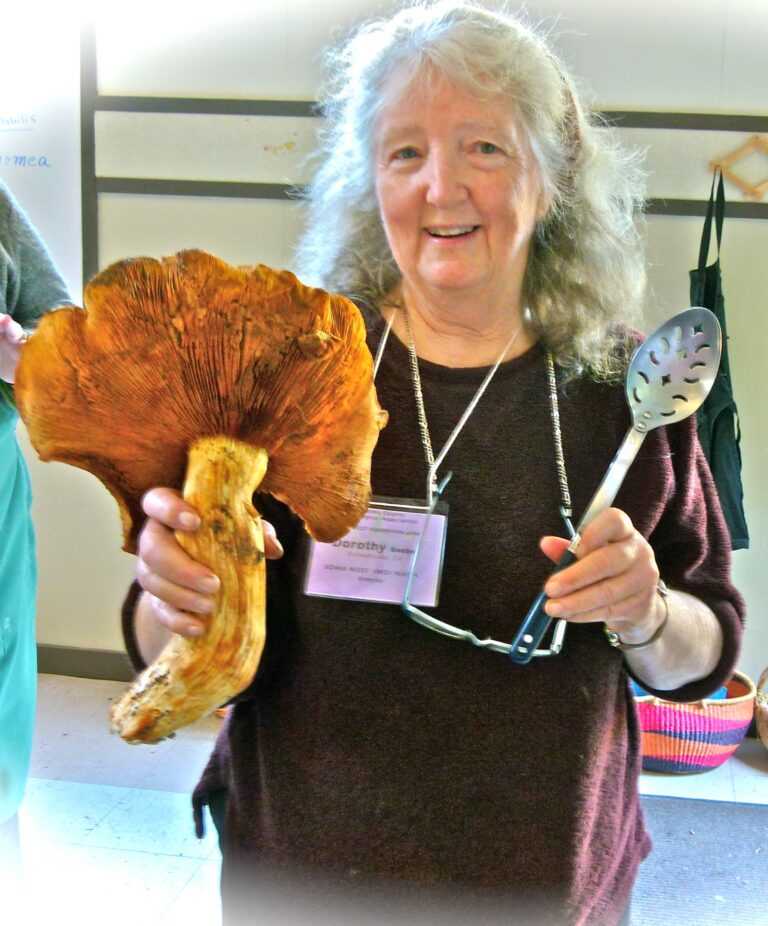
Dorothy Beebee Scientific illustrator and mushroom dyer Dorothy Beebee is a scientific illustrator and mushroom dyer, who documented Miriam C. Rice’s mushroom dye research and illustrated Miriam’s books for over 40 years. Dorothy assisted Miriam in presenting mushroom dye workshops around the world. She also designed and maintained the original www.mushroomsforcolor.com website for 15 years. Dorothy became impassioned with the rich and varied colors produced by fungi, and documented her adventures with Miriam and their decades-long friendship in both drawings of fungi and in articles. For over 40 years, Dorothy assisted Miriam in presenting mushroom dye workshops for mycological societies around the USA, at International Mushroom Dye Symposia, and designed and maintained the original website www.mushroomsforcolor.com for 15 years (now the official website for the IMDI and under the direction of Miriam’s daughter, Felicia Rice). Dorothy Beebee (from mushroomsforcolor.com). Upcoming Santa Cruz Fungus Fair Talks Buy Tickets History of Mushroom Dyes Sunday, January 13, 2013 12:00 PM - 1:00 PM Room 1 Past Santa Cruz Fungus Fair Talks History of Mushroom Dyes Santa Cruz Fungus Fair Sunday, January 13, 2013 12:00 PM - 1:00 PM Room 1
- Learn About Mushrooms | Fungus Federation of Santa Cruz
Learn About Mushrooms The Fungus Federation of Santa Cruz is all about educating its members and the general public about the dangers and delights of collecting, studying, consuming , and creating art with wild mushrooms. We understand that people learn in different ways. We aim to offer something for everyone! Winter Chanterelles Bunch. Photo by Yevgeny Nyden Classes & Speakers FFSC members take ID classes & workshops from our science advisors to learn the systematic procedures of mushroom identification. This is particularly critical for anyone planning to eat wild mushrooms. We host monthly speakers , and also invite speakers to present at the Santa Cruz Fungus Fair and some of our Long Distance Forays . Plus, we share recipes for mushroom dishes, along with information about external classes for people interested in photographing mushrooms, cooking mushrooms, and even creating crafts with mushrooms! Online Learning Our Featured Fungi pages highlight some of the local (and few not-so-local) mushrooms that you may find in your wanderings, courtesy of our current and past science advisors and foray leaders. As tech evolves, we're also experimenting with new ways to share tips and advice to help people learn about mushrooms! Check out our free FFSC Online Learning area for our first few programs on how to get started with collecting and identifying mushrooms. Note: The educational content we provide on this website is intended to supplement (not replace) formal classes, published books and field guides. Informal Knowledge Sharing Many FFSC members enjoy sharing their knowledge and experience via our Google Group mailing list, as well as in person at our club events, and at our biggest event: The Santa Cruz Fungus Fair. Knowledgeable members of FFSC make themselves available to provide mushroom ID services to others. (In fact, local hospitals have consulted with a select group of our science advisors for many years, to evaluate mushroom poisoning cases.) Special Projects & Scholarships Are you working on a mycology project at your school? FFSC offers scholarships and grants to support STEM and mycology research. See our Scholarships page for more information. More Resources Other Mycological Clubs Other Nonprofit Resources Members Only Content Login Join FFSC