Search this site
646 results found with an empty search
- Strobilurus trullisatus | Fungus Federation of Santa Cruz
Strobilurus trullisatus. 2013, Fort Bragg. Photo by Hugh Smith Strobilurus trullisatus Hugh Smith Strobilurus trullisatus forms colonies on old Douglas fir cones. Thank you, Hugh, for this lovely photograph! Camera (Not provided) Focal L. Aperture Shutter Sp. ISO Flash Photo taken on January 19, 2015 Mushroom(s) ... Previous Photo Back to Gallery Next Photo
- Auriscalpium vulgare on Pinecone | Fungus Federation of Santa Cruz
Auriscalpium vulgare (Soquel, 2016). Photo by Cass Fuentes Auriscalpium vulgare on Pinecone Cass Fuentes Exploring the Soquel Demonstration Forest at the FFSC local foray in February, and though the weather was amazing, the fleshy fungi were few and far between... None-the-less, there was some really cool finds, including Hericium coralloides (a choice edible related to Lion's Mane), and Auriscalpium vulgare . Camera (Not provided) Focal L. Aperture Shutter Sp. ISO Flash Photo taken on February 20, 2016 Mushroom(s) ... Previous Photo Back to Gallery Next Photo
- Inky Caps - from "Basic Inky Cap ID for California" | Fungus Federation of Santa Cruz
Inky Caps - from "Basic Inky Cap ID for California" "Out of the millions of different kinds of fungi out there, I think that inky caps are the coolest by far. They are called inky caps because they dissolve into black ink when they get old. They are also often misidentified, so I put together a list of the common inky caps and their differences." by Peter Vahlberg Coprinopsis lagopus gr. Photo by Terry Way Editors note: FFSC member Peter Vahlberg posted "Basic Inky Cap ID for California" on iNaturalist in 2020, and FFSC previously reprinted a copy on this website. Going forward, you can read Peter's original article on iNaturalist instead, for the latest comments and updates. In the meantime, enjoy these quick links to the inky cap species that Peter describes in his article: The genus Coprinus includes the edible shaggy mane ( Coprinus comatus ) and a close look-alike, Coprinus calyptratus . www.inaturalist.org Shaggy Mane (Coprinus comatus) Shaggy Mane from Dan Foley Park, Solano County, US-CA, US on November 19, 2016 at 12:38 PM by Peter Vahlberg www.inaturalist.org Star-capped Coprinus (Coprinus calyptratus) Coprinus calyptratus is a species of fungus in the family Agaricaceae. It is commonly known as the star-capped coprinus. (Source: Wikipedia, 'Coprinus calyptratus', https://en.wikipedia.org/wiki/Coprinus_calyptratus, CC BY-SA 3.0 . Photo: (c) Pete Siminski, some rights reserved (CC BY-NC), uploaded by Pete Siminski) The Coprinopsis group includes Coprinopsis lagopus and Coprinopsis atramentaria . www.inaturalist.org hare's foot inkcap (Coprinopsis lagopus) hare's foot inkcap from Jackson Demonstration State Forest, Mendocino County, US-CA, US on December 7, 2018 at 03:42 PM by Peter Vahlberg www.inaturalist.org Common Ink Cap (Coprinopsis atramentaria) Common Ink Cap from Santa Clara County, US-CA, US on January 30, 2018 at 04:45 PM by Peter Vahlberg Coprinellus includes Coprinellus micaceus (the mica cap) and Coprinellus flocculosus . www.inaturalist.org mica cap (Coprinellus micaceus) mica cap from 2755 Glorietta Cir, Santa Clara, CA, US on December 25, 2018 at 04:12 PM by Peter Vahlberg www.inaturalist.org flocculose inkcap (Coprinellus flocculosus) flocculose inkcap from Golden Gate Natl. Rec. Area - SF, San Francisco County, Golden Gate National Recreation Area, US-CA, US on October 28, 2017 at 09:21 AM by Peter Vahlberg An unnamed species in California looks similar to C. micaceus , but Peter believes it is Coprinellus radians . www.inaturalist.org Genus Coprinellus Coprinellus from Rancho San Antonio County Park, Los Altos, CA, US on December 25, 2018 at 03:37 PM by Peter Vahlberg www.inaturalist.org Coprinellus radians Coprinellus radians is a species of mushroom in the family Psathyrellaceae. First described as Agaricus radians by the mycologist John Baptiste Henri Joseph Desmazières in 1828, it was later transferred to the genus Coprinellus in 2001. (Source: Wikipedia, 'Coprinellus radians', https://en.wikipedia.org/wiki/Coprinellus_radians, CC BY-SA 3.0 . Photo: (c) judymac, some rights reserved (CC BY-NC), uploaded by judymac) Coprinellus disseminatus does not turn inky. www.inaturalist.org Trooping Crumble Cap (Coprinellus disseminatus) Trooping Crumble Cap from Monte Bello Open Space Preserve, Santa Clara County, US-CA, US on December 28, 2018 at 11:08 AM by Peter Vahlberg The genus Parasola are hard to ID without a microscope. www.inaturalist.org Genus Parasola Parasola from Santa Clara County, US-CA, US on June 30, 2017 at 10:34 AM by Peter Vahlberg Parasola auricoma is easier to identify, along with Parasola conopilus (which looks like Psathyrella corrugis ). www.inaturalist.org goldenhaired inkcap (Parasola auricoma) goldenhaired inkcap from Bay Rd, Menlo Park, CA, US on October 19, 2019 at 11:31 AM by Peter Vahlberg More inky caps exist, but can be hard to identify without a microscope. www.inaturalist.org Inkcaps (Genus Coprinopsis) Inkcaps from Henry Cowell Redwoods State Park, Santa Cruz County, US-CA, US on December 14, 2018 at 09:33 AM by Peter Vahlberg Mushrooms covered: Coprinellus disseminatus (fairy inkcap) Coprinellus flocculosus (flocculose inkcap, woolly inkcap) Coprinellus micaceus grp. (mica cap) Coprinellus radians (orange-mat coprinus) Coprinopsis atramentaria (common ink cap, inky cap) Coprinopsis lagopus (hare's foot inkcap, harefoot mushroom, rabbit's foot inky cap) Coprinopsis sp. (inky cap) Coprinus calyptratus (star-capped coprinus) Coprinus comatus Coprinus sp. (inky caps) Parasola auricoma (goldenhaired inkcap) Parasola conopilus (pleated inkcap) Previous Description All Featured Fungi Next Description
- John Brown | Fungus Federation of Santa Cruz
John Brown Got Inocybes? FFSC TITLE: Minister emeritus MEMBER SINCE : 1992 John started started his ministership in Stores and finished in Science. In recent years his attention was devoted to an independent study of the genus Inocybe, with mentoring from Dr. Dennis Desjardin. John was known for his patience and good humor, especially with novice mushroomers. PiPi Valley was his favorite place to hunt boletes. R.I.P. John Brown Upcoming Santa Cruz Fungus Fair Talks Buy Tickets Past Santa Cruz Fungus Fair Talks
- Aureoboletus mirabilis | Fungus Federation of Santa Cruz
Aureoboletus (Boletus) mirabilis, Puget Sound. Photo by Yevgeny Nyden Aureoboletus mirabilis Yevgeny Nyden Aureoboletus (Boletus) mirabilis , commonly known as the admirable bolete, the bragger's bolete, and the velvet top, is an edible species of fungus in the Boletaceae mushroom family. ( Wikipedia ) I took this photo in the Olympic National Park, Washington when I was visiting the Puget Sound Wild Mushroom Show. Camera Samsung SGH-M919 Focal L. 4mm Aperture f/2.2 Shutter Sp. 1/700s ISO 1000 Flash Off Photo taken on October 13, 2013 Mushroom(s) ... Previous Photo Back to Gallery Next Photo
- Albion Long Distance Forays | Fungus Federation of Santa Cruz
Albion Long Distance Forays Our Albion forays are weekend-long trips to the Mendocino area, where chanterelles, black trumpets, and more can be found. We travel to the Mendocino Coast twice a year to explore this bountiful haven for fungal species: Albion I in December: Early winter brings a wide range of fungi, including edibles such as boletes, matsutake, chanterelles, candy caps and more. Albion II in January: Bounties of black trumpets, hedgehogs and winter chanterelles greet us as we revisit the area during late winter. Tickets for Albion forays usually go on sale 2 or 3 months in advance and often sell out quickly. Check Upcoming Events for the latest status. If you can't make one of these fabulous events, monitor this website and FFSC's Google or Facebook group to find out when the next Albion foray will be held. Please note: You must be a member of FFSC to participate in our Albion forays. Saturday Activities On Saturday we meet at 8:30am to discuss the day's plans, and then we head out to hunt! We usually explore areas like Salt Point on our way up and journey home and mainly around Jackson Demonstration State Forest. Afterwards, we share potluck appetizers and dinner, learn from our Science Officer and occasional special guest speaker. After the potluck, we waddle and gather in the lab area to review and identify our foray findings. We encourage all participants who want to learn more about mushrooms to come and help out with the ID. Lodging Our hub for lodging and the potluck is the Albion Retreat and Learning Center , located just one mile from the seashore, eight miles south of Mendocino, 28 miles from a state forest, and 60 miles from Salt Point in the valley of an old lumber camp on the Albion River. The Albion Field Station is owned and operated by Pacific Union College. It has welcomed students and visitors with its rustic charm since 1947. The campus has a large dining hall with a commercial kitchen that will be available to all participants. We utilize the kitchen for individual meals and our famous Saturday night potluck. The following prices are approximate, based on past Albion Forays (and are thus subject to change for future Albion dates). All ticket options include the Saturday activities, plus your choice of lodging. An Albion cabin for 4 people (~$260 - $400 per cabin) A dorm bed in a shared Albion cabin (~$100 per bed) An RV space at Albion with a hookup (bring your own RV) (~$180 per space) No lodging at Albion; participate in Saturday events only ($40 non-refundable) Check in is on Friday afternoon, and we clean up and check out on Sunday morning. (There are no group activities formally planned on these days. Participants socialize and make plans for hunting in the area.) As with all FFSC events, the prices are determined by facility rental costs, vendor fees, insurance costs, etc. Event staff are all unpaid volunteers. Reservation Info & Policies Expand each FAQ item to see the details. Albion Cabins/beds All cabins have shared rooms. Some cabins are fully handicap accessible, some have bunk beds, and some have beds in a loft. The loft option is best for kids and the more limber. You can specify your preference when you order tickets, and we will do our best to accommodate your preference. Albion RV spaces As the access road is fairly narrow and curvy, and can be icy, this option is best for smaller motor homes. The recommended size is 30' or smaller. The largest to have navigated down the winding narrow road has been 38' but you must be a very good RV driver. Saturday activities only If you prefer to arrange your own accommodations offsite, you may purchase a ticket to participate the Saturday activities. The Saturday ticket is non-refundable . (The ticket covers a share of the group permit, cafeteria rental, etc., which FFSC must pay in advance and the vendors do not give refunds.) Cabin and RV space assignments Cabin, dorm bed, and RV space assignments will be sent out before the event and will be posted on the door at the main office at Albion. The lodging reservations are for Friday night (check-in after 3PM) and Saturday night, with checkout on Sunday before 11AM. Albion Cabins owned by Pacific Union College How to buy tickets When tickets go on sale, FFSC members will see a button or link to buy a ticket (reservation). You'll be able to choose which type of ticket you want (entire cabin, individual bed, RV space, or just the Saturday events). You will be able to add each ticket to your shopping basket before paying. Cancellation policy Saturday-only tickets are non-refundable . Lodging (cabin, bed, RV space) tickets are partially refundable IF you cancel more than 14 days before the start date. The club will refund the price you paid minus the payment processor's service fees (usually 3% - 5% of the price). No refunds for lodging tickets will be issued if you cancel within 10 days before the start date. Alternatively, you are welcome to find another FFSC member to buy your ticket(s) for the full price you paid. Be sure they read the policies before purchasing your ticket, and inform the trip leader of the change. If you have questions about this event before purchasing a ticket, use the Contact FFSC form on this website, or use our Google Group or Facebook group (info available on the Contact FFSC page, too). If you purchase a ticket, our Minister of Long-Distance Forays or an event volunteer will follow up with you to provide any additional details. What to Bring Based on members' experiences with this event, we suggest you include the following gear: Potluck dish & cabin supplies For the cabins and Saturday night potluck, plan to bring the following at a minimum: A dish to share at the Saturday potluck. Review our Potluck Essentials page when planning what to serve. Bedding, pillows, towels, and toiletries for yourself. A dehydrator if you have one - damp mushrooms don’t last very long, so make sure you can enjoy them long after the trip! Alternatively, you can cook your mushrooms and keep them refrigerated in your cabin or the dining area. See Culinary Techniques . Saturday foray gear For the Saturday foray, we recommend you bring: GPS, a walking stick, a loud whistle, and a water bottle Collecting gear (basket, knife, brush, wax and/or paper collection bags) Layers of clothing - weather ranges from mild to wet and cold. Keep your head and feet dry! If you're new to collecting and to mushroom identification, we suggest you read our free FFSC Online Learning pages for basic info and tips. Event Policies & FAQs Albion Field Station Policies STRICT NO PET POLICY : Albion Retreat and Learning center has a "NO PETS POLICY". If you violate this policy, you will be fined $250 and be asked to immediately clean your room/cabin and check out. Service animals are OK (with permission first) in handicap units only (Vanessa 1 or 2). Please make sure you reserve the right type of cabin for your needs. Animals can't be in cars overnight or in food prep areas. Proof of current shots must be provided. Upon registration, please note that you wish to bring a service dog in the comments section at checkout. You may also be required to be answer these questions if you intend to bring a service dog: (1) whether the animal is required because of a disability, and (2) what work the animal is trained to perform. Clean meats in rooms : The Albion Field Station is owned by Pacific Union College, a private college for the Seventh-day Adventist learning community. The organization eats clean meats, and respectfully requests that there be no pork, bacon, crab, shellfish, squid or octopus cooked in the kitchenettes. Alcohol is not allowed on site : Evidence of alcohol containers, corks, corkscrews, etc. - including any in the garbage--is grounds for the FFSC being banned from using this wonderful facility in the future. Masks are still recommended in the buildings. FFSC Long-Distance Foray Policies By registering for and attending this event, you are also agreeing to these policies: Potluck Essentials : You agree that you understand acceptable mushroom species to serve. Personal Responsibility : FFSC is not responsible for any harm caused by potluck dishes or collected mushrooms that are eaten, handled or prepared inappropriately. Participants are responsible for deciding what to eat. Contact Poison Control if an emergency occurs. Collection Ethics & Etiquette : Help us make sure local and state agencies keep allowing us to collect mushrooms! Additional Policies for Long-Distance Forays : You agree you understand the risks, and how long-distance forays are typically operated. Please login as an FFSC member to see additional policies and other information below. Members Only Content Login Join FFSC
- Top Ten Poisonous Mushrooms of California | Fungus Federation of Santa Cruz
Top Ten Poisonous Mushrooms of California Many people come to the love of mushrooms through eating them, and many people don’t eat them because they can be very poisonous. by Douglas Smith Omphalotus olivascens. © Douglas Smith (from mushroomobserver.org) Concerns about poisonous mushrooms outweigh the love of mushrooms in the general populace, and in a few species these concerns are valid. To go into the woods to find mushrooms for food is noble, but to know mushrooms that are poisonous is to be safe. People should be careful, and get to know poisonous species before they start to eat mushrooms they gather themselves from the wild. Plus these can be interesting mushrooms to find: some are common, some are beautiful. If you are planning on finding mushrooms for food in the wild, as an extra challenge for the season this year and for safety’s sake, try to find and ID these also. Just make sure you don’t eat them! For ID confirmation, come to one of FFSC's events; join our Google Group, or try other resources where experts can be found. (See our FAQs for links.) This list was compiled with help from Mike Beug, Professor Emeritus of Evergreen State College, Olympia WA. The Toxicology Chair of the North American Mycological Society, Mike has been compiling stats on mushroom poisonings for years, and was very helpful in creating this list. The list is the top ten weighted by the seriousness of the poisoning along with the number of poisoning cases from the western US each year. 1. The Death Cap — Amanita phalloides Amanita phalloides . © Douglas Smith (from mushroomobserver.org) The Death Cap is the most deadly of mushroom species, accounting for more deaths that any other. It contains amanita toxins which block cells’ ability to function, and then destroys the liver. A. phalloides causes serious illness, liver damage or failure, and death. Each year a few cases of this occur in California, usually from people moving here that were used to eating edible Amanitas at home. Identity can be determined by a thick base with a volval sack, off-white grey to grey-green cap, and bright white stipe, gills, and partial veil. Usually found with live oak in California, there are rare sightings with other oaks reported. Common in the Bay Area and south, it is slowly moving out to other areas of California, and can be found from Mendocino to Los Angeles, and east through the central valley. 2. The Destroying Angel — Amanita ocreata Amanita ocreata . © Darvin DeShazer (from mushroomobserver.org) A mushroom as deadly as A. phalloides , also containing the deadly amanita toxins. This one causes fewer deaths, because it seems to be eaten less often. Perhaps because while A. phalloides is found early to mid-season, this one is usually found mid to late-season. Still a serious concern, and can be confused with the fairly popular local edible Amanita velosa , which shares the same season and habitat. This species has a similar base and stipe to A. phalloides , with the thick base, and volva, and the same bright white stipe, gills, and thin partial veil. This species differs in that the cap is usually off-white, sometimes with a tan central disc, and rarely with pink colors in the tan. The partial veil on the stipe of this one is so thin, it often disappears, something to keep in mind for a careful ID. 3. Green Spored Parasol — Chlorophyllum molybdites Chlorophyllum molybdites . © Nathan Wilson (from mushroomobserver.org) The most common cause for poisoning cases in the USA, but this is more true in the midwest and east than for California. Causes severe gastrointestinal distress in most people, and enough to cause some to end up in the hospital. Usually confused with the edible Shaggy Parasol ( Chlorophyllum rachodes / brunneum ) which it can look very similar, except the poisonous species has green spores, and the edible species have white spores. Found in grassy places, and landscaping. 4. The Fly Agaric — Amanita muscaria and A. pantherina Amanita pantherina. © Darvin DeShazer (from mushroomobserver.org) Amanita muscaria subsp. flavivolvata. © Darvin DeShazer (from mushroomobserver.org) A tie for fourth place, these two species have similar effects on people, and cause similar numbers of cases in the west. These contain muscimol and ibotenic acid which produce a number of effects in people, from severe sickness to fever, sweating, and delirium. Along with being poisonous, it is also one of the most popular mushrooms from the wild. If someone asks me to ID this fantastic mushroom they saw hiking, it is usually the A. muscaria . These are very common species in California, found among pine and fir trees. 5. The Western Jack-o-Lantern — Omphalotus olivascens Omphalotus olivascens . © Douglas Smith (from mushroomobserver.org) This mushroom causes gastrointestinal upset. It’s a “wishful thinking” poisoning: if compared for long enough with a chanterelle picture, "maybe it will be OK to eat!" Although this mushroom isn’t really that close to the chanterelle, they do share orangish colors, and a vaguely vase-shaped body form. The Jack-o-Lantern is different in that it often grows clustered, on wood, with brown-green colors, and thick, true gills in comparison to the vein-like false gills of the chanterelle. 6. The Deadly Galerina — Galerina marginata ( autumnalis ) Galerina marginata . © Mke Woods (mykoweb.com) A small brown mushroom, this one also contains the amanita toxins that are found in A. phalloides , and can be a quite serious and deadly mushroom if eaten. It is rarely eaten, and almost never confused with any mushrooms used for food, but it could be confused with Psilocybin mushrooms if those were desired. Found on wood, it is small, brown, and usually with a fibrous veil near the top of the stipe, that is brown with adherent spores. 7. The False Morel — Gyromitra esculenta Gyromitra esculenta . © Fred Stevens (from mykoweb.com) A spring-time ascomycete that shares the same season and habitat with the popular edible Morels. This is a confusing mushroom in term of edibility: it was called a choice edible for years, but it contains poisons that get processed into monomethylhydrazine in the body. The tolerance for this chemical in the body is extremely variable, going from nothing to kidney failure. This is the cause of many serious poisonings in the midwest, but poisonings are rare in California. 8. Psilocybin mushrooms — Psilocybe coprophila / cyanescens and others Psilocybe cyanescens . © Fred Stevens (from mykoweb.com) This is a collection of species that contain the chemicals psilocybin and psilocin, which are hallucinogens. They cause confusion and delirium in people, and send a few to the hospital each year. These are more a concern for small children, where their low body weight makes the effect stronger, and at least one case of death of a small child is attributed to these. Small brown mushrooms with deep purple-brown to black spores, they usually stain blue when bruised. Depending on species they grow on either wood chips or dung. 9. False puffballs — Scleroderma polyrhizum / cepa / areolatum Scleroderma areolatum . © Darvin DeShazer (from mushroomobserver.org) These are similar to puffballs, growing on the ground, with spores developing inside. They differ from other puffballs with a thick yellow-brown skin, a yellowish inside when young, and spores that are purple-black when mature. Other puffballs develop deep brown spores. They have caused kidney/liver failure in pigs and dogs, but this hasn’t been seen in people yet. Poisonings of these are rare in the US, but more common in California, perhaps due to the popularity of puffballs for the table here. Make sure you can ID Scleroderma before eating any puffballs. 10. Poison Pax — Paxillus involutus Paxillus involutus . © Mike Woods (mykoweb.com) A species that is sometimes eaten in Europe, but it contains poisons that result in kidney failure if they build up in your system. There are some deaths attributed to the mushroom, but poisonings seem to be rare in California, perhaps because it is such a drab and fairly ugly mushroom in our area. This can be identified by its vase shape, long decurrent gills, and brown velvety cap. And wait, there’s more... Mike Beug actually put a surprise species higher on the list here — Morels! — Morchella elata / esculenta Morchella elata . © Nathan Wilson (from mykoweb.com) Although these are a top ten edible, when raw and undercooked they account for a number of poisoning cases in California. I’ve pushed this to an afterword to point out other species and keep the top ten format, but people should keep this in mind when eating morels. Mushrooms covered: Amanita muscaria Amanita ocreata (Western destroying angel) Amanita pantherina Amanita phalloides ( death cap) Chlorophyllum molybdites (green-spored parasol, green-spored lepiota, the vomiter) Galerina marginata (deadly galerina, funeral bell) Morchella elata (black morel) Morchella esculenta (yellow morel) Omphalotus olivascens ( western jack-o'-lantern) Paxillus involutus (brown roll-rim, common roll-rim) Psilocybe cyanescens ( wavy cap) Scleroderma areolatum (leopard earthball, leopard-spotted earthball) Scleroderma cepa (smooth earthball, onion earthball) Scleroderma polyrhizum (many-rooted earthball, dead man's hand) Previous Description All Featured Fungi Next Description
- Dorothy Beebee | Fungus Federation of Santa Cruz
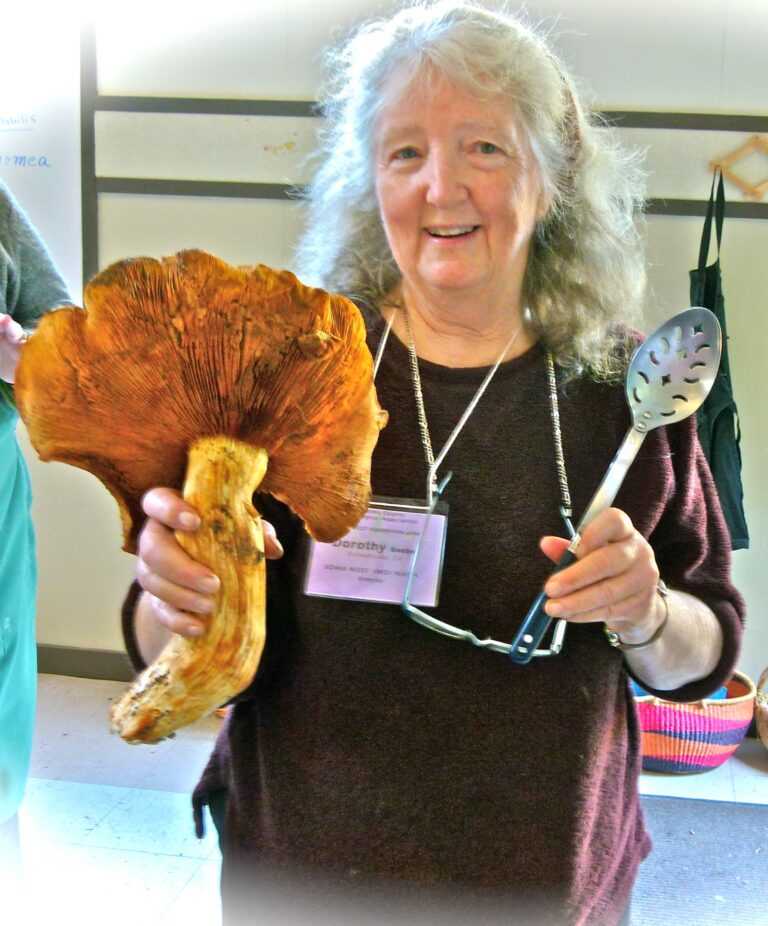
Dorothy Beebee Scientific illustrator and mushroom dyer Dorothy Beebee is a scientific illustrator and mushroom dyer, who documented Miriam C. Rice’s mushroom dye research and illustrated Miriam’s books for over 40 years. Dorothy assisted Miriam in presenting mushroom dye workshops around the world. She also designed and maintained the original www.mushroomsforcolor.com website for 15 years. Dorothy became impassioned with the rich and varied colors produced by fungi, and documented her adventures with Miriam and their decades-long friendship in both drawings of fungi and in articles. For over 40 years, Dorothy assisted Miriam in presenting mushroom dye workshops for mycological societies around the USA, at International Mushroom Dye Symposia, and designed and maintained the original website www.mushroomsforcolor.com for 15 years (now the official website for the IMDI and under the direction of Miriam’s daughter, Felicia Rice). Dorothy Beebee (from mushroomsforcolor.com). Upcoming Santa Cruz Fungus Fair Talks Buy Tickets History of Mushroom Dyes Sunday, January 13, 2013 12:00 PM - 1:00 PM Room 1 Past Santa Cruz Fungus Fair Talks History of Mushroom Dyes Santa Cruz Fungus Fair Sunday, January 13, 2013 12:00 PM - 1:00 PM Room 1
- Learn About Mushrooms | Fungus Federation of Santa Cruz
Learn About Mushrooms The Fungus Federation of Santa Cruz is all about educating its members and the general public about the dangers and delights of collecting, studying, consuming , and creating art with wild mushrooms. We understand that people learn in different ways. We aim to offer something for everyone! Winter Chanterelles Bunch. Photo by Yevgeny Nyden Classes & Speakers FFSC members take ID classes & workshops from our science advisors to learn the systematic procedures of mushroom identification. This is particularly critical for anyone planning to eat wild mushrooms. We host monthly speakers , and also invite speakers to present at the Santa Cruz Fungus Fair and some of our Long Distance Forays . Plus, we share recipes for mushroom dishes, along with information about external classes for people interested in photographing mushrooms, cooking mushrooms, and even creating crafts with mushrooms! Online Learning Our Featured Fungi pages highlight some of the local (and few not-so-local) mushrooms that you may find in your wanderings, courtesy of our current and past science advisors and foray leaders. As tech evolves, we're also experimenting with new ways to share tips and advice to help people learn about mushrooms! Check out our free FFSC Online Learning area for our first few programs on how to get started with collecting and identifying mushrooms. Note: The educational content we provide on this website is intended to supplement (not replace) formal classes, published books and field guides. Informal Knowledge Sharing Many FFSC members enjoy sharing their knowledge and experience via our Google Group mailing list, as well as in person at our club events, and at our biggest event: The Santa Cruz Fungus Fair. Knowledgeable members of FFSC make themselves available to provide mushroom ID services to others. (In fact, local hospitals have consulted with a select group of our science advisors for many years, to evaluate mushroom poisoning cases.) Special Projects & Scholarships Are you working on a mycology project at your school? FFSC offers scholarships and grants to support STEM and mycology research. See our Scholarships page for more information. More Resources Other Mycological Clubs Other Nonprofit Resources Members Only Content Login Join FFSC
- Fermentation Friday workshop | Fungus Federation of Santa Cruz
Fermentation Friday workshop Shane Peterson, Master Fermentologist of Farmhouse Culture fame, will be our fearless leader. He’ll do a demo, share tastings, and instruct us in creating a few of our own ferments to take home. Join us and bring a friend! This workshop will introduce us to new ways to preserve all the extra mushrooms we find...perhaps during our spring forays in the Sierras. Since this is a new event for our group, some of you were asking for more information about what to expect: Shane will give a lecture on lacto-fermentation and the traditional practice of fermenting mushrooms as a means of preservation. He’ll share tools, tips, and insights into the fermentation processes and methodologies, as well as discuss fermenting a variety of mushrooms using different formulas and techniques. Shane will share his tried and true recipe for lacto-fermented brined mushrooms, do a demo of the recipe, and discuss multiple variations. We’ll then shift gears to the workshop portion of the evening, and everyone will make their own batch of Shane’s Foragers Delight Mushroom Kraut to take home and ferment. We will wrap it up with a small tasting of ferments that Shane & Team prepared for the event, as well as a brief Q&A if time permits. After this deep dive, you’ll be confident in lacto-fermenting your own flush of mushrooms next season (or sooner). Kick off your weekend and come geek out on fermentation and mushrooms with us! Each attendee will need to bring prep supplies for the workshop. Large cutting board Chef’s knife Paring knife Shredder (for carrots) Extra large Bowl Prep bowls (2) Apron Kitchen scale (if you have one) Vegetables and fermenting containers/lids will be provided, the cost of which is included in the ticket price. Shane Peterson, author of The Farmhouse Culture Guide to Fermenting, is a master fermenter, product developer, and best-selling cookbook author with 20 years of experience working in the fermented food and beverage industry. His first book Fermentering (2015) was a best-seller in Denmark, and eventually was published throughout Scandinavia. As head Fermentologist for Farmhouse Culture he created many award winning product lines. Shane is an advocate for the rewilding of the human microbiome and the human spirit, and uses the craft of fermentation as a vessel to explore our connection to the Earth and the microcosmos. An ardent lover of nature, he spends much of his time hiking, trail running, and foraging the trails of Northern California. Shane consults for fermented food companies and leads fermentation workshops both in the U.S. and abroad. FFSC Member Prices: $40 individual $50 for 2 partners sharing materials Log in to your member's account to get the access code below to buy tickets at the member price. Non-Member Prices: $60 individual $70 for 2 partners sharing materials The fees for this workshop are used to offset the cost of facilities rental, workshop materials, and instructor stipend. The 2026 class is sold out. Annual membership to the Fungus Federation is just $25, so please consider becoming a member to get the best pricing for this workshop, along with all the other priceless benefits of membership! Join Here: https://www.ffsc.us/pricing-plans/list Members Only Content Login Join FFSC
- Cream of Wild Mushroom Soup | Fungus Federation of Santa Cruz
Cream of Wild Mushroom Soup We have several wonderful creamy soups in our list of recipes here, and here's an especially creamy one. by Deb Boletus edulis. © dietel (CC-BY-NC) (from inaturalist.org, obs. 322510983) Method Reconstitute dried mushrooms in Madeira for 1 hour. Sauté onions in butter over low heat in a soup pot, stirring occasionally, until translucent and tender (about 15 minutes). Clean fresh mushrooms, slice thin and add to onions. Sauté until cooked (about 15 minutes). Add the drained reconstituted mushrooms to the pot, reserving the liquid (Madeira). Strain or carefully decant the reserved Madeira into the soup pot, leaving gritty residue behind. Add chicken stock and bring to a boil. Reduce heat and simmer, covered, for 45 minutes. Puree the solids in a food processor or blender until smooth, adding 1 cup of liquid. Combine remaining liquid, heat over medium heat and season to taste. Thin with half & half or cream if soup is too thick or if it just seems like a good idea. Bring up to temperature and serve. Recipe contributed: December 1996 Objective: Soup Total Time: About 3 hours Yield: 4 servings Suggested Mushrooms: Porcini (Boletus edulis, Boletus regineus, Boletus rex-veris) Portobello/portabella, champignon, cremini, button (Agaricus bisporus) Yellowfoot (winter chanterelle) (Craterellus tubaeformis) Join FFSC or renew your membership to access the rest of this content. Join FFSC Login as an FFSC member to access the rest of this content. Login Ingredients 2 oz. dried mushrooms* 2 lbs. fresh mushrooms* 3/4 cups Madeira wine 8 Tbs (1 Stick) butter 2 cups finely chopped onions 4 cups chicken stock** 1 pint cream or half & half Salt & freshly ground black pepper, to taste A soup pot Food processor or blender * You can use cremini for the bulk of the fresh mushrooms, and then a wild dried mushroom such as yellowfoot (left whole and don't overcook) or porcini (chopped fine). ** Preferably homemade chicken stock. If you must use canned stock, go for the lower sodium version. It's far from low-sodium, but it won't render your soup inedible. Previous Recipe All Recipes Next Recipe
- Puffball Hushpuppies | Fungus Federation of Santa Cruz
Puffball Hushpuppies Hushpuffies ? Here'a fun twist on hushpuppies, made with giant puffballs! by Shea Moss Calvatia booniana. © Zane Walker (CC-BY-NC) (inaturalist.org obs. 283647904) Method Sauté the linguiça until barely pink, then remove and reserve. Add the diced puffballs to the same pan and pour the vegetable oil over the puffballs. Toss to mix well, then sauté the puffballs. The puffballs will absorb the oil and then begin to give off their water. Continue sautéeing until the liquid has evaporated. Add the diced green peppers. Cook for 3 minutes, then remove and set aside to cool. In a 2-quart mixing bowl, whisk the egg together with the milk. Sift the cornmeal, baking powder, salt and cayenne pepper together, then add the dry ingredients to the mixing bowl and blend well. Fold in the chopped linguiça and the sautéed mushrooms until well-incorporated. Let stand for 15 minutes. Heat 1-inch of vegetable oil in a heavy frying pan to 400°F or until it pops when you (carefully) put a drop of batter or water into it. Pat a tablespoon of puffball batter into a ball and gently drop it into the hot oil. Deep fry the hushpuppies, turning over once, until golden and crisp. Lift out the hushpuppies as they are done, and place on a wire rack, or on paper towels to drain. Serve as soon as they can be handled without burning your fingers. Hot Coriander Chutney Blend the chutney ingredients to create a spicy dip. Other condiments are also excellent as dipping sauces: Any chutney Sweet Hawaiian style mustard Horseradish sauce Hot mustard with a catsup swirl Sweet and sour sauce Sweet and tangy BBQ sauce Recipe contributed: October 1988 Certain puffball species are considered edible when young and the gleba is still firm and white (like marshmallow or tofu). However, be very sure of your ID, because there are inedible and toxic species and lookalikes such earthballs, stalked puffballs, Amanita eggs (i.e., Amanita that are still enclosed in their universal veil). Serve with a couple of dipping sauces, one sweet and one spicy. My favorite dipping sauce is a hot coriander chutney, which I've included in this recipe. Objective: Appetizer Total Time: 30 mins Yield: About 20 pieces Suggested Mushrooms: Puffball (Calbovista subsculpta, Calvatia booniana, Calvatia gigantea, Lycoperdon perlatum) Join FFSC or renew your membership to access the rest of this content. Join FFSC Login as an FFSC member to access the rest of this content. Login Ingredients 1/4 lb. linguica, diced 2 cups puffballs, peeled and diced 4 Tbsp. vegetable oil 1/4 cup bell pepper, diced 1/2 cup cornmeal 1/4 cup flour 1 1/4 tsp. double acting baking powder 1/8 tsp. salt 1/8 tsp. cayenne pepper 1/4 cup milk 1 whole egg Hot Coriander Chutney 1 tsp. sugar 1/4 tsp. black pepper 1/4 cup fresh lemon juice 1/4 cup water 2 firmly packed cups of coriander leaves, stems and roots 1/4 cup grated coconut 1/4 cup chopped onions 2 Tbsp. freshly grated ginger root 3 tsp. jalapeño pepper, finely chopped (or to taste) Previous Recipe All Recipes Next Recipe