279 results found with an empty search
- Taylor Lockwood's National Geographic Magazine Debut | Fungus Federation of Santa Cruz
News & Stories / Taylor Lockwood's National Geographic Magazine Debut Dear friends -- In the past twenty-five years or so I have been sending major publications some of my best images in hopes of getting them to see mushrooms as nature's art instead of dried up moldy pieces of science. That's o.k. too but I'm going for nature's beauty here. Taylor Lockwood • February 12, 2014 Bioluminescent mushrooms. © Taylor Lockwood It has been very frustrating and I've written letters detailing my thoughts about their aesthetic fungophobia -- but I didn't send them. I decided to take the high road and keep photographing and sending images until there was one to which they could not say "no". My persistence has paid off. In the May, 2014 issue, in their front section, Visions of Earth, National Geographic Magazine is going to feature one of my mushroom photos in a two page spread. To their credit, they picked one of the best mushroom photos of my career -- bioluminescent mushrooms with no other light than from the light of the moon. That image (above) and many more will be in this year's "Spirits of the Forest" tour in the fall. This is a great day for mushrooms. And, to the many people who have bought my "mushroom items", booked shows, given advice, helped with editing and identifications, provided hospitality as well as other support, this is not just my success; it is your success too. This is not a time to "rest upon laurels". I feel even more charged than before. To that end, I'll be going to Brazil again this Friday and Australia/New Zealand next month. I hope to see you on the "Spirits of the Forest" tour in the fall, Taylor Editor's Note: As of 2026, a photo of the 2-page spread is available in the National Geographic Photographic archive channel (@geoarchive_) on Instagram. Members Only Content Login Join FFSC Related Posts Cam Cam by Taylor Lockwood Bioluminescent Mushrooms from Spirits of the Forest Previous Article All News & Stories Next Article
- FAQs and Directions to the Fungus Fair | Fungus Federation of Santa Cruz
FAQs and Directions to the Fungus Fair The Santa Cruz Fungus Fair is just a short walk from downtown Santa Cruz. Get intel on parking, directions and more below. FAQs What's Free and What Requires a Ticket? Shopping Areas FREE areas include the vendor areas in Laurel Park; and the vendor rooms, food court, and hallway artwork exhibits inside London Nelson Community Center (space permitting). Interactive Areas and Open Talks Buy General Admission tickets to enter: The Fungi Forest and mushroom displays The Craft Room Any of the open talks (space permitting) and demos that are included with General Admission GA tickets are free for kids under 12 years old Want to visit the General Admission areas for free? Volunteer to help with the Fair! Headliner Talks Headliner talks in Room 3 require a General Admission ticket plus an additional ticket per talk. Buy Tickets Fungus Fair After Hours Dinner The Fungus Fair After Hours Dinner requires separate tickets per person. 2026 Santa Cruz Fungus Fair After Hours Dinner January 9, 2026, 5:30 – 9:30 PM London Nelson Community Center Register Now Directions and Parking 301 Center St, Santa Cruz, CA 95060, USA Location The Santa Cruz Fungus Fair is held at London Nelson Community Center (at Laurel Park) in Santa Cruz, CA. The London Nelson Community Center is a hub for social, recreational, and cultural activities for the Santa Cruz community. Directions If you're planning to attend one of the open or headliner talks, give yourself plenty of time and plan to arrive early. Admission lines tend to get longer before each talk. From Hwy 17 and Hwy 1 North interchange: Proceed North on Hwy 1. Cross Mission Street. Stay in center lane and merge straight onto Chestnut Street. Go downhill and turn left on Laurel. Londen Nelson Community Center is on the left, at the corner of Laurel and Center Streets Parking Santa Cruz offers free and metered street parking and lots, bike racks and metered bicycle lockers, and parking passes. You may park on city streets nearby if space is available. Check signs for restrictions and time limits. Additional parking is available on Center Street near the police station. There is also plenty of parking downtown and it is only a few minutes walk away. A few spaces for cars with blue disabled person placards are available around the building. More info: Santa Cruz Downtown Parking Lot Facilities & Map , City of Santa Cruz Santa Cruz Downtown Parking , Downtown Association of Santa Cruz Public Transit The nearest Santa Cruz Metro bus stop is Laurel & Center .
- Collecting Conditions in Mendocino at ACCF 2014 | Fungus Federation of Santa Cruz
News & Stories / Field Reports Collecting Conditions in Mendocino at ACCF 2014 I went to the All California Clubs Foray (ACCF) in Albion last weekend. We actually found an amazingly large number of mushrooms so the myco-geeks were thrilled. Edibles? - only a few chanterelles, hedgehogs and winter chanterelles. Phil Carpenter • February 27, 2014 Fomitopsis pinicola. © Ember Erebus (from mushroomobserver.org) I just wanted to let you all know that it is my opinion that the right decision was made to cancel Albion II. All of the "usual" places were dry, dry, dry and essentially devoid of fungi. We all sought out the deepest canyons that never saw the sun to find damp spots to collect. Even then, things were sparse (especially edibles). With a lot of people gathering and spending the time, we had plenty of diversity and things to discuss. I thoroughly enjoyed working with the excellent mycologists present to continue my education. It was a good call to bring this subject up for a vote, Wendy! I agree that our group would have been disappointed. Members Only Content Login Join FFSC Related Posts Report from the Mendocino Coast 2018 December Albion Foray Species List Previous Article All News & Stories Next Article
- Memories of Matsutake | Fungus Federation of Santa Cruz
News & Stories / Memories of Matsutake I grew up picking matsutake in the pacific northwest with my dad. We joined the first chapter of the Puget Sound Mycological Society and would go on field trips. It is one of my most precious memories and in the Northwest. The whole Japanese community buzzes with matsutake talk in the fall. Wendy Tokuda • March 3, 2016 Tricholoma murrillianum (magnivelare) (matsutake). Photo by Hugh Smith I was struck when I visited Mendocino for the first time because so much of the vegetation there was simliar to the Northwest and felt like it would be good for matsutake. In the Northwest the host plants are blue huckleberry, salal, and doug fir. In California, I'm having to learn about the strikingly different host plants for mushrooms I grew up picking. My mom wrote an essay about them, reprinted below. Memories of Matsutake (September, 1983) Indian summer brings some golden weather but the air has a sharp edge. There is frost on the grass some mornings and windshields have to be scraped. Now is when the Japanese community in Seattle perks up it ears for the first reports of the pine mushroom "matsutake". Thus begins the annual ritual of autumn. "Hear Yamamoto got some matsutake from someone. Must have come from Rainier area. It's only the middle of September.", George says when he comes home from visiting a neighbor. "Oh", I reply but I think to myself that now he won't be able to stay still. Is it going to be this coming weekend? No, we're retired so we can beat the crowd by going Thursday perhaps. "Let's take a run out there since the weather's so nice anyways, " he says. Anyone else?" I ask. "I'll call Bob and John, " he replies. Wednesday night I make some rice balls and teriyaki chicken, and George gets his hiking sticks, compass, and a cotton sack for carrying the mushrooms. Thursday morning, Bob and John come by at 7, old men but they are grinning like little boys that know something. Bob's driving, and we load our gear in his old Buick truck and climb into the back seat. "Too bad it didn't rain a little more last week. I think it's been too dry. We'll try Crystal Spring, they come out early there." "You going to take us to your secret spot this year?" George asks Bob. "No use taking secrets like that to the grave." "I'm taking them," says Bob. They start talking about a neighbor that had a stroke a few days ago. It used to be that so and so's wife ran off with someone or see that new barmaid at Bush, but lately it's talk and isn't so cheerful. Yet I don't feel as upset as I used to get about people getting sick or dying. I guess there isn't time to waste on feeling sorry for those who drop dead when I feel like I dodging bullets myself. George has snuggled into the corner of the seat and is dozing off. I feel it's not fair to sleep when Bob has to drive. "How come Mary didn't come?" "Someone has to work. She's watching the shop today." I forgot that not everyone has retired. "Too bad" I say but already I'm yawning and feeling warm. I try valiantly to go on. "How's your daughter getting along with the new baby?" Bob starts to describe the baby boy, how it looks Japanese one day and Jewish the next, but then despite all my efforts I fall asleep. The car jolts to a stop and both George and I wake up. We seem to have arrived someplace. I glance at my watch and discover it's been an hour and half ride. "Remember this place?" John says. I look out to see a huge mountainside of tree stumps. "Where are we?" I ask. "It's by Blueberry Creek." That beautiful forest and all those mushrooms reduced to an expanse of sawed off stumps. We are silent. Every year some former haunt disappears and a familiar place we're looking for is wiped out. Over and over, to become old is to find ourselves strangers in our own world. "We're not getting any matsutake here." says Bob and he starts up the car. We drive on some bumpy roads by so many beautiful creeks and forests and every place looks good, like it might be a spot we ought to stop and explore. Suddenly John says, "Hold it. I remember this place. Just a little ways in, I know a place." We tumble out of the car, stiff after nearly two hours of riding. I feel for my compass and whistle in my pocket. Bob has opened the car trunk and we grab our walking sticks and bags. I brought a little basket so the mushrooms won't get ground together with the dirt. The men start drinking tea and I have just a sip, holding back because thre are no bathrooms in the forest and I'm with three men. Bob bangs the trunk door down and John is already in the woods. I can see his orange knit cap bobbing up and down as he hurries toward some spot. George holds back to wait for me and he shouts to the other two, "let's meet back here in an hour and a half". We start trudging toward the forest, stepping over bushes and I think about Christmas. I must have stepped on some fir and it's fragrance of the holidays floating through the woods. The brush on the edge of the woods disappears and it's easy walking now. I try to keep up with George as he tramps ahead of me. Already he has forgotten me and his head is down looking for signs of matsutake, trying not to miss any suspicious white cracks in the ground. My vision is always half of his back as the idea of being lost in the woods terrifies me and it's the sight of the trees, the woods, the feeling of being embraced in the world of nature that I seek. Once again I feel at home under the quiet trees, apart from the crush of human entanglements. I press on the outside world drops away. There is only the occasional crack of twigs, the sudden scurrying of a chipmunk, the flash of a bird in flight. George and I are as we were when we first met. I follow in silence and we are suddenly in a clear space covered with bright green moss. Over the moss grows some little white mushrooms. Their caps are white, light, and small. Their thin stems are almost invisible. I feel a sensation of floating. These mushrooms seem to be suspended, motionless, and I understand why fairies are associated with these delicate ethereal mushrooms. I stand for a moment and stare at the lovely sight. I wish my children and parents were here with me now. Eventually the children will enjoy the same trip, some day, but alas, these joys are no longer for my parents. It was on a long ago October day when the autumn skies were gloriously blue and clear like today when I saw Dad for the last time. George had gone mushrooming the day before and I took two matsutake for him. His wrinkled brown face was all smiles, his eyes brightened and I could feel worlds of past memories unfoling in his mind. "George went to the Cascades yesterday," I said and then rushed outside to pursue some errand. As I started driving off, I saw him waving goodbye from the window. That turned out to be the last time I saw him alive. Mom called about 5 o'clock that day and said Dad hadn't returned. After I left them he had taken one of the two matsutake or perhaps the beautiful day must have pushed him on to visit other friends. He walked further and further, finally taking the bus to the Public Market where a friend had a flower stall. Was he bidding farewell to every one? He boarded a bus in the 5 o'clock downtown rush and suffered a heart attack. Do we pick a time to go? I think he did. Tricholoma magnivelare (matsutake) Suddenly as I stand mezmerized by the floating mushroom caps, I see something and I can't believe it. Near my feet there is a crack in the mossy floor and I see that something white is showing under the moss. I hurriedly lift the dirt and moss, and there is a matsutake. The fragrance is unmistakeable as I use the pick of my walking stick to dig it out. I lay it on the green moss and see that this stem is a good inch and a half in diameter and the white shaggy cap, not fully opened, hugs the stem. The first matsutake of the season. It's like seeing an old friend. No other picked or seen later in the season will be as wonderful. Suddenly, I feel alone and I call out for George. There is no answer. I look up and the gently swaying tops of the trees merge together layer after layer into the distance. It is like staring into deep waters. I fumble around for my whistle and realize my throat is dry. I blow frantically so that anyone for miles around can surely hear me but there is no answer. I put the mushroom in my basket and tell myself to stay calm. I take out my compass but realize I hadn't taken a reading on the way in. If only I hadn't stopped. Knowing George's relentless speed I should have kept up with him. I decide to stay put and keep blowing my whistle. Finally I hear a whistle responding but I can't tell which direction it's coming from. "George, George," I keep screaming, repeating, determined not to lose his response. Suddenly I can fathom the direction and I shout, "Don't move," and start trudging in that direction hanging on to my basket and stick. After an interminable mad scramble I catch sight of his red Scottish beret. "Were you lost?" he asks. He hadn't really missed me. "Got one, huh?. That's a beauty," he says. I want to explain to him the terror I had just experienced but he seems to be in a world of his own. Besides there is no time because he starts pushing ahead, always running this way and that to follow up on all the little clues that seem to beckon him from all over the forest floor. I have my one, and I now feel my only interest is not to get lost. It's the first time I got one before he did and I realize his eyesight isn't as sharp as it used to be. He used to have 20/20 vision but lately he's been thinking of getting glasses. Still his mushroom sense is sharp, he seems to smell them out, and my the time this trip is over he'll have far more than I do. He always does. Sure enough at that moment he's stooped down and he's yelling for me to hurry. Climbing over a few logs I reach him by the base of a tree and he's found three, no, it turns out to be five as he uproots the first few. "Only reason I saw it, the deer had eaten the cap off of one and it was sitting there completely exposed." He dusts off the brown needles and the bits of dirt. How different from the old days when he just threw it into the bag, dirt and all, rotten ones and all. Now he admires them, each one, takes time to clean it. Then he pats the dirt down over the disrupted ground and we start out again. "Its going to be a good year, " he says and I notice there are all sorts showing here and there. There are the shiny little orange cups in a line running over the logs. There are the purple ones and those that look like toasted rounds of bread. The brown velvet caps that remind me of animal backs. Once in a while I skirt around bear and deer droppings, reminding me that we humans are not alone. Sometimes I actually catch the scent of deer but I don't recall ever running into one. They must hear us lumbering through the woods from long distances away. I glance at my watch and tell George it's time to start back. "Just that little spot over that log," he says. Sometimes it's harder to get George out of the woods than to find the matsutake. "No, let's give ourselves at least twenty minutes to find our way back. You know how you hate it when others don't get back in time." So reluctantly he pulls out his compass and we start our trek back. But all the while we are trudging his eyes keep scouting all over the ground and indeed he does find a few. "Isn't it funny you walk over the same path and you always find some you missed." I agree but I don't find anymore. When we return, Bob and John are already waiting. The truck is open and they are looking for lunch and beer. I look for the tea and see their matsutake spread out in 2 separate wooden crates, carefully arranged on fresh fir boughs. There are seven in one and three in the other. George and I arrange ours in a box together. There are ten, my one and his nine, some only as big as a thumb. "George, I think it's mother must be crying for that one," I say, pointing to the little one. "Yeh, but look at this one," he says, picking one up that looks like it must weigh a quarter pound. "I found it next to the one eaten by deer." We all pause to admire it. The cap is shiny, as if sheer silk is drawn over it. Some sunlight must filter in, even into these dense woods to give a sheen to the slightly tan cap. The shaggy stem has bits of thick soft veil clinging to it. There are signs of rich black loam clinging to the upper part of the stem but the base is gray with dry dirt. The twisted stem gives the feeling it has struggled to rise out of the ground and triumphed. I sigh in wonder and George is smiling. Tricholoma murrillianum (magnivelare) (matsutake). Photo by Hugh Smith Everyone in the party has found matsutake, a rare and joyous event for a first trip of the season. Of course, we intend to take in a few more spots after a little rest. I think to myself, we all made it again. Together. How nice. I untie the white dishcloth wrapped around our lunch box and pass the rice balls to Bob, John and George. Members Only Content Login Join FFSC Related Posts Lost: The Companion's View Reality Check: Dispelling a Myth Previous Article All News & Stories Next Article
- Relishing Medicinal Mushrooms Part II | Fungus Federation of Santa Cruz
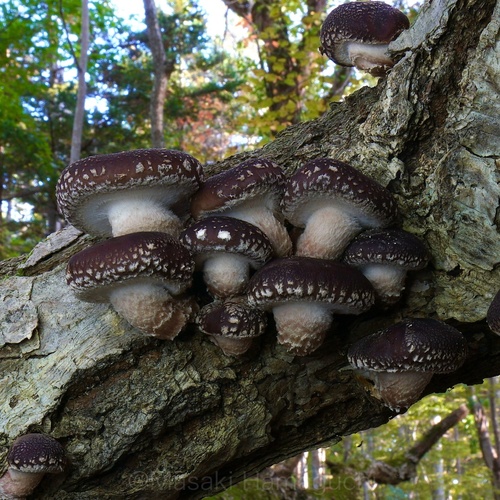
News & Stories / Mycology & Art News Relishing Medicinal Mushrooms Part II Food Is Medicine Coach/Chef Zachary Mazi welcomes you back to our two-part journey into the use of medicinal mushrooms in cooking. Chef Zachary Mazi • April 1, 2013 Photo copyright by Masaki Hamaguchi (https://www.inaturalist.org/photos/443071643) In the first part, we visited the history and use of medicinal mushrooms, and attempt to answer why, at this time in our history, we are inundated with a wealth of new knowledge on the subject. Now, in part 2, we will explore the medicinal values of many of our favorite edibles. We will also include more delicious recipes that Food Is Medicine has created to really relish this delicious medicine. In part 1, we explored the historical context for our desire to know more about mushroom medicines, learned a few of their traditional uses, and learned how vast and truly varied the subject is! Indeed, every year, scores of new studies using medicinal mushrooms and their fractionated parts and pieces are being explored. Their pharmaceutical grade, nearly side-effect-free medicines are indeed being eyed as the next cash crop for pharmaceutical manufacture. The results of these studies are often times staggering, as many of the medicines tackle some very trying problems such as cancer, heart disease, diabetes and brain disease, while leaving few of the side effects associated with our current medications. In certain cases, these medicines make changes in how our bodies respond in ways that can last long after the medicine is no longer ingested. Our body is physically changed! In order for our medicine to be able to utilized in cooking, it must either be medicinal when eaten in its whole form (bio-available) or it must be extractable in water, hot or cold. Miraculously, almost all of our commonly eaten mushrooms that you are likely to find in the grocery store, or even a local foray in the fall, have medicines that are available either from the tea, or decoction, or from consumption of the whole mushroom, either cooked or dried. Without leaving the comfort of Button, Shiitake, Chanterelle, Oyster, Morel, Porcini, Maitake, Chicken of the Woods, Cauliflower, and Matsutake mushrooms, we can find effective medicines for the nervous, digestive, skeletal, circulatory, and immune systems. In addition, within this small (and delicious) medicine cabinet, we also find help for skin disorders, and almost all specimens instigate positive tumor growth modulation, many even help with controlling viruses such as HIV/AIDS and hepatitis. And all of the above have some anti-microbial properties. Chicken of the Woods, or Laetiporeus sulphureus kills E.coli on contact! Sparassis crispa, the cauliflower mushrooms has shown promise against drug-resistant super bacteria… we may demand medicinal mushrooms in the near future if our antibiotic use continues unchecked. Maitake mushrooms seem to have more recorded health effects and means of deriving medicines than any of the above, and many of the medicines derived from this delicious mushroom require complex laboratories. Just Google “maitake medicine” and sit down for a long read. Laboratory or not, there is no reason to stop eating them! Just within this small and extremely accessible selection of fungi, we find vitamins A (and beta carotene), the entire B complex, C, D, K, CoQ10, minerals such as iodine, magnesium, iron, copper, gold, potassium, germanium, zinc, many diverse amino acids, including the essential eight we can’t manufacture in our bodies and must get from the environment. Not to mention a library of thousands of molecules both small and extremely large, (like the polysaccharides such as the beta-glucans that are receiving the spotlight for their clear role in cancer prevention and reversal) arranged bio-chemically into incredibly diverse suites of molecules, many newly discovered and named for their sources exclusive to the parent fungi (Rogers). There is great benefit in exploring the commonly known and recognized mushrooms for medicines. Many of them have been written about for more than a millennium, as in the case of shiitake ( Lentinula edodes , mentioned in part 1). Most common edibles—because of their relative accessibility—have been more thoroughly researched and studied over the past fifty years than many of the more obscure and difficult to access medicinal fungi. Unfortunately, it would take a book to talk about all of the benefits of each of these mushrooms, so we will touch on five of the most popular edibles, and leave the rest for another article or conversation…this topic is as vast as the unknown Kingdom itself. Agaricus It seems fitting, to discuss the delicious and healing properties of mushrooms in the order of popularity and familiarity. One mushroom amongst all others, so well known that it is the default that comes to mind when “eating mushrooms” is mentioned: the Agaricus mushroom. It is commonly known as the button mushroom, the crimini mushroom, or the mighty Portobello (the “adult” crimini). All three of these belong to the Agaricus bisporus (or A. brunnescens , depending upon whom you ask), and indeed there are a number of Agaricus mushrooms not commonly eaten that can provide powerful medicines as well, such as the Horse mushroom ( A. arvensis ), and the field mushroom ( A. campestris ). The common button mushroom has been used in Chinese medicine for many centuries, for easing indigestion, and increasing appetite. In 2008, the Journal of Nutrition published the following about a study at Tufts University: “The results suggest that white button mushrooms may promote immune function by increasing production of antiviral and other proteins that are released by cells while seeking to protect and repair tissue.”(3) White button mushrooms! The US produces 500 million pounds of white button mushrooms every year, a portion of the world trade, and of these almost 350 million pounds are grown near Kennett Square, PA, USA(4), which holds a yearly mushroom fest open to the public. Unfortunately, it is also one of the most common crops to rely on the heavy use of pesticides and preservatives like hydrogen peroxide, which is used to prevent browning and kill invaders(2). It is important to seek organic mushrooms exclusively, as these mass produced mushrooms are generally not washed before being served in even the most elegant eating establishments. What’s more, uncooked button mushrooms contain the carcinogen agaritine, a potentially lethal chemical in the hydrazine family (think: rocket fuel) that seems to break down during cooking. Some texts purport, however, that as much as 75% of the toxin does not even break down in cooking, and that long binges on these mushrooms can cause a toxic build-up in the body of these potentially lethal chemicals. The Agaricus is probably not a good everyday mushroom, but certainly not one to be simply forgotten in lieu of the more exotic mushrooms to which we now turn our attention. The medicine is in the mushroom! Shiitake Second in commercial popularity only to the Agaricus is the shiitake mushrooms ( Lentinula edodes ), which have now taken a significant bite out of the multi-billion dollar industry of white button mushrooms during their 30 year rise in use and popularity. These are flavorful and indispensible addition to the refrigerator pharmacy. First, they are easy to grow at home, even easier to find at almost any grocery store, and are often grown locally because of their viability as a crop. Second, very few pesticides are needed to grow these beauties; and third, both their taste and texture can be well adapted to almost any style of cuisine despite their Japanese origins. Shiitake mushrooms have some very powerful medicines indeed. They have been shown to possess compounds that lower triglycerides, cholesterol and phospholipids in blood; decrease bile cholesterol while increasing bile acids, helping to emulsify and digest fats more readily. They are an effective alternative to statin type drugs, which have negative side effects, and decrease blood glucose and increase insulin in diabetic patients. In addition, they are immuno-stimulating, with better recorded activity than Trametes , Cordyceps and Ganoderma (reishi) mushrooms, all of which are currently getting more press than the humble shiitake for their respective medicines! Hot water extracts of shiitake, besides making a delicious miso soup broth, are effective in breast cancer inhibition, and one of the isolated compounds is medically prescribed in Japan for gastric cancer, lung cancer and melanoma. They work with the body systems, and are effective in stimulating the body’s own immune system against the offending cancer cell. In one trial the extract, applied externally to skin carcinoma, induced cell death in the cancer cell and had zero reaction in the adjacent healthy skin cells. Amazing! (Stamets). Even more amazing, they are anti-candida, and hot water extracts inhibit herpes, equine encephalitis, polio, measles, and mumps! The juice of the mushroom was especially effective against E. coli and Staphylococcus aureus , but left the beneficial bacteria in even better condition due to the presence and preference of their mushroom sugars! While some immune reactions have been recorded with shiitakes, it has usually involved dramatic exposure to the mushrooms, such as farm workers or gluttonous binges, rather than normal individual consumption. Eat shiitakes everyday. Coming next month: Oysters, Chanterelles and Morels Members Only Content Login Join FFSC Related Posts Relishing Medicinal Mushrooms Part III Relishing Medicinal Mushrooms Part I Previous Article All News & Stories Next Article
- Spring Fungi of the Sierra Nevada, 2014 | Fungus Federation of Santa Cruz
News & Stories / Spring Fungi of the Sierra Nevada, 2014 (Cancelled) Once again, Dennis Desjardin and San Francisco State University will be offering their week-long class at the SFSU Sierra Field Station. Students will be introduced to the different kinds of mushrooms and other large fungi that occur in the spring in the Sierra Nevada. Cortinarius • March 30, 2014 Photo by Brian Perry, hosted on the sierra.sfsu.edu website Updated March 9, 2014: Sorry, this class is cancelled due to dry conditions. Emphasis will be placed on the analysis of macro- and micromorphological features, as well as ecological roles, to aid in the identification of taxa. The daily class routine consists of an 8:00-10:00 am lecture followed by a field trip until approx. 3:00 pm. Transportation on the field trips will be by car pooling. Upon return to the camp, collections will be examined and identified in the laboratory (3:30-6:00 pm) in collaboration with the instructor and a knowledgeable graduate student assistant. All equipment, microscope slides, cover slips and reagents required for accurate determination of specimens will be provided. In the evenings, several lectures and slide shows will be presented, and the laboratory will be open for additional work on collections. If sufficient quantities of edible fungi are collected, they will be prepared for consumption and served to the class by the camp's chef. Class runs June 1-6, 2014. Tuition is $348 with additional costs for room and board. For further information on the class, visit the San Francisco State University website. Spaces are available as of April 12, but don't delay too long. This class always fills up! Members Only Content Login Join FFSC Related Posts Microscopy of Gilled Mushrooms Previous Article All News & Stories Next Article
- FFSC Financials | Fungus Federation of Santa Cruz
FFSC Financials Our Minister of Exchequer counts everything (except how many mushrooms we collected...) Have a better photo? Photo by Fungibartl (Dan Tischler) FFSC is a 501(c)(3) nonprofit organization. (Learn more about FFSC and our mission .) How We Use Fees that We Collect Santa Cruz Fungus Fair: This is our primary fundraising event of the year. In addition to raising money for scholarships and to pay our speakers, this volunteer-run event supports our community with three days of fun, food, entertainment and education. Scholarships and Grants: We use a portion of our membership fees, event fees, and other fundraising to support students and researchers who are expanding the world's knowledge of fungi. Learn more or apply for funding on our Scholarships page. Educational Speakers: The fees also fully or partially subsidize the cost of bringing in guest speakers to present a variety of topics to the general public and our members. These include our FREE Monthly Speakers events, as well as speakers at other events like the annual Santa Cruz Fungus Fair. Event Tickets: FFSC's event fees (when charged) typically cover external costs such as optional accommodations (for long-distance forays), venue rentals (for classes and dinners), each venue's liability insurance requirements, charitable fundraising, and/or guest chefs. Product Inventory: We offer club T-shirts, stickers, and other items for sale to members and the general public at cost (or with great discounts). We use some of our fees to pay vendors up front to make the items, or to reimburse volunteers for the cost of out-of-pocket supplies. We also buy mushroom books to sell at or near cost to members and the public at our events. Operational Costs: The remainder of the fees cover costs such as venue rentals, equipment rentals and decor for club dinners, liability insurance requirements, legal fees, and (rarely) vendors/contractors when none of our volunteers are qualified or available to do certain work. Plus, we pay for storage units to hold FFSC inventory, booth equipment (signage, tables, chairs, etc.), customized Fungus Fair decor and more, in cases when volunteers don't have room in their own garages. What about Staff? FFSC's club leaders (ministers), trip leaders, ID class instructors, event organizers, and event staff are all unpaid volunteers! We do this because we are passionate about mycology! Here are some of the past financial statements for the Fungus Federation of Santa Cruz. FFSC Balance Sheet Aug 31-2025 .pdf Download PDF • 178KB FFSC 2024FY P&L .pdf Download PDF • 177KB FFSC-2023-Balance-Sheet .pdf Download PDF • 29KB FFSC-2022FY-PandL .pdf Download PDF • 30KB FFSC-PandL-2021-22 .pdf Download PDF • 180KB FFSC-PandL-2018-19 .pdf Download PDF • 108KB Members Only Content Login Join FFSC
- Media and Publicity | Fungus Federation of Santa Cruz
Media and Publicity If you're a member of the press or just looking for news about the Fungus Fair, we've collected useful info for you below. Fungus Fair Logo Artwork Members of the press are welcome to download and use these Santa Cruz Fungus Fair art files for publication. Please credit the artists and copyright holders. 2026 Santa Cruz Fungus Fair Logo This year we held a logo design contest focusing on “Underground Wonders: Secrets of the Fungal Kingdom” as the 2026 Fair theme. The winning design was created by Viel Xander Olaguera (@vxolaguera) from Torrance, CA. The logo will be used on this year's T-shirts, posters, and postcards. Plus, several of the other contest entries will be on display during the Fair. The 2026 logo uses the concept of “wood wide web” to emphasize the underground network of fungi that connects our world's plants. The design portrays the following California fungi, selected for their different features (from left to right and down): Zombie-ant fungus ( Ophiocordyceps unilateralis ), growing from its host carpenter ant A lobster mushroom ( Hypomyces lactifluorum ), a parasitic fungus best known as an edible delicacy and for dyeing textiles A King Bolete ( Boletus edulis ), better-known in grocery stores and restaurants as "porcini" Honey fungus ( Armillaria mellea ), a plant pathogen known to arborists as "oak root rot," to the curious for its bioluminescent mycelium, and to others for its subtle nutty and sweet flavor A death cap ( Amanita phalloides ), one of the most poisonous fungi in the world Mycelium, as the "wood wide web" Inspired by the bioluminescence of honey fungus mycelium, the logo on this year's Fungus Fair T-shirt will also glow in the dark! If you use the 2026 Santa Cruz Fungus Fair logo in publications, please include these credits near the image: Artist: Viel Xander Olaguera © Fungus Federation of Santa Cruz Fungus Federation of Santa Cruz Logo You are welcome to include the FFSC logo in news articles, and visit the Santa Cruz Museum of Natural History's website for their logo. Example of FFSC Logo Downloads FFSC logo, with full name FFSC-logo-full-transparent_2x .png Download PNG • 845KB FFSC logo, acronym only ffsc-logo-circle-only-transp .png Download PNG • 330KB FFSC logo SVG (small) .svg Download SVG • 201KB 2026 Fungus Fair Poster and Postcard Vector Images (PDF) If you use the poster or postcard images, please include these credits near the image: Logo Artist: Viel Xander Olaguera Poster Layout : Lynn Piquett © Fungus Federation of Santa Cruz 2026 Fair Postcard and Poster .pdf Download PDF • 2.12MB Past Fungus Fair Photos for Publication 301 Center St, Santa Cruz, CA 95060, USA Feel free to download and use any of the images on this page for your articles in conjunction with the Santa Cruz Fungus Fair. We ask that you please credit the photographers. Thanks! Past Fungus Fair Posters Check out some of our past Santa Cruz Fungus Fair poster artwork too! Fungus Fair Poster Archive History of the Fungus Fair The Fungus Fair originated in 1974 at the Santa Cruz Museum of Natural History, led by the efforts of David Arora, who went on to write “ All That the Rain Promises and More ” and “ Mushrooms Demystified ”, which is widely considered to be one of the best and most comprehensive mushroom guidebooks available. As the Fungus Fair grew, it found new homes throughout the county, including Harvey West Park and London Nelson Community Center. During the pandemic years of 2021-2023, the Fair took on new forms, as the Virtual and Outdoor Fair with a full week of live video lectures plus two weekends of small group, expert guided forays, and the Mini Fungus Fair held at the Santa Cruz Museum of Natural History. In January of 2024 the Fungus Federation of Santa Cruz partnered again with the Santa Cruz Natural History Museum to bring the Fungus Fair triumphantly back to the London Nelson Community Center, celebrating the 50th anniversary with our largest event ever. The 2026 Santa Cruz Fungus Fair will be the 39th Fungus Fair organized by the Fungus Federation of Santa Cruz. Visit the FFSC History page for more about the origins of the Santa Cruz Fungus Fair. The Great Hall, at the Santa Cruz Fungus Fair Press Releases and News 2026 Fair Press Release and Contacts 2026 Fungus Fair_Press Release .pdf Download PDF • 495KB Santa Cruz Fungus Fair in the News On the FFSC Website Fungus Fair News Past News about the Fungus Fair Fungus Federation of Santa Cruz hosts 51st Fungi Fair, KAZU Santa Cruz Fungus Fair returns to the London Nelson Center , Santa Cruz Sentinel The 50th Anniversary Fungus Fair brings mushroom mania to Santa Cruz , KAZU Fungus are Among Us , Palo Alto Online 46th annual Santa Cruz Fungus Fair , KSBW Past Fungus Fair Videos Visit the Fungus Federation of Santa Cruz YouTube channel (@ffscmedia) for more videos.
- Contact FFSC | Fungus Federation of Santa Cruz
Contact FFSC Got questions? Here are ways to connect in person, by email, on social media, and more. Science advisors Phil and Thea helping people ID their mushrooms FFSC Mailing Address PO Box 82, Santa Cruz, CA 95063-0082 How to Reach Us in Person You're welcome to talk to us in person at our free Monthly Speaker & Social at the Santa Cruz Live Oak Grange, or any of our other upcoming events . Many FFSC events are open to the public. Join Our Online Conversations Our members and community connect and share online in a few ways: Our Facebook group FFSC on Instagram ( @scfungusfed ) FFSC on YouTube ( @ffscmedia ) The FFSC projects on iNaturalist Our community mailing list (a Google Group). See the FAQs below for links and details on how to subscribe. FAQs What is included in a Household Membership? A single household membership covers two adults and minor children. Membership entitles your household to additional details on this website, access to members-only events, and more. See our Why Join FFSC? page for details and membership FAQs. What is the FFSC Google Group mailing list, and why would I join it? Google provides a Groups feature, which allows you to join a group and to share information in files and by email. Anyone in the FFSC Google Group can announce upcoming mushroom-related events, share photos of mushrooms and FFSC events, send and answer mushroom ID requests, and have other group conversations via email. (SPAM is not permitted, of course.) If you choose not to join FFSC's Google Group mailing list, you can still find out about most FFSC events on this website, and you can use the form below to submit mushroom ID requests. How do I join the FFSC Google Group mailing list? Go to https://groups.google.com/g/ffsc and request to join the group. You'll need to sign in with your Google account (see the next question below). We'll usually add you to the mailing list within a few days. What is a Google account? Do I need a "gmail.com" email address? You can create a Google account with any email address. You don't need a Gmail address to have a Google account. (That said, if you already have a Gmail address, then you already have a Google account!) If you don't have a Google account, you can either: Create a Google account with a new Gmail address ; or Use your own email to create a Google account . (For more info about this option, see " Use an existing email address " on the Google Support website .) I joined the Google Group mailing list. Why can't I login or send email to it? If your request was approved a while ago, but you haven't been receiving emails or you can't login to the Group , double-check which email you used when you joined the Google Group. (It might be different from the email you used for your FFSC club membership and this website.) Still stuck? Use the form below and choose “FFSC Google Group issue” as the area of interest, so we can help you figure it out. I have a problem with my account Check our FFSC Account FAQs for a few common questions. If you still need help, use the form below. I need help identifying a mushroom We're happy to help! Here are some options: Bring your specimen to one of our in-person events (our monthly speaker events are free and open to the public)! Join our Google Group (see the answers above) and describe your mushroom there. (Review Photography for ID Purposes before submitting ID photos to the Google Group, and treat all ID answers as suggestions for your own research; not as definitive identifications of what is safe to eat.) Try the California Mushroom Identification Forum (on Facebook), iNaturalist , or MushroomObserver . Why can't I submit a mushroom ID request here? To accurately identify a mushroom, someone needs to smell it, feel it, taste it, hear or sense how it breaks, evaluate a spore print, and in some cases run chemical or other tests on it. If you can't bring a mushroom in person, the next best option is to use an online forum where others can guide your verification process. Got More Questions? If you have a question about a specific event, see that event’s page (or the email you received when you bought your ticket) for the best way to contact the coordinators. For general questions about FFSC, or if you're having issues with your club membership, feel free to contact us by using the form below. Contact Us First name* Last name Email* Topic Area (choose one)* Mushroom ID request FFSC Membership FFSC Google Group FFSC Hotline Speaker / interview invite FFSC event FFSC Website issue Fungus Fair Vendor Scholarship application Other Message Subject* Message* Submit
- Cam Cam by Taylor Lockwood | Fungus Federation of Santa Cruz
News & Stories / Mycology & Art News Cam Cam by Taylor Lockwood Cam Cam is a short video of mushrooms and original music by Taylor Lockwood. Yevgeny Nyden • June 21, 2014 A photo from Taylor's "Cam Cam" YouTube video. © Taylor Lockwood A short video clip from Taylor F. Lockwood: Cam Cam (39 seconds) with some of his new "Brazilian" music. It will be included in Taylor's latest video project, Spirits of the Forest. Members Only Content Login Join FFSC Related Posts Taylor Lockwood's National Geographic Magazine Debut Bioluminescent Mushrooms from Spirits of the Forest Previous Article All News & Stories Next Article
- Spring Long Distance Foray | Fungus Federation of Santa Cruz
Spring Long Distance Foray Join our Spring Foray when the snow melts in the Sierra Nevada mountains, and enjoy the vernal appearance of morels, coccoras, woodland agaricus and early boletes. FFSC's first Spring Foray was in 1987, led by Brad Beebe. Brad would scout the Sierras for morels in multiple locations in April and decide a week or so prior where he would lead. It was so well received that it was established as an annual foray. This is a loose gathering for FFSC members. Everyone finds their own camping spot and hunts on their own. The only fixed event is the Saturday night potluck. Everyone meets at a designated location, brings chairs, their dish, drinks, eating gear and firewood. Everyone helps clean up and we are sure to have good food, drinks, laughter as we share our hunt stories around the fire. Members Only Content Login Join FFSC
- Four Dry Season Mushrooms | Fungus Federation of Santa Cruz
Four Dry Season Mushrooms At the beginning of the season, while we wait patiently for the fall rains to arrive, there are still some interesting sporocarps lurking in our local outdoor spaces. ... Two Princes Oyster mushrooms ( Pleurotus ostreatus ) and the Prince ( Agaricus augustus ) often fruit in the summer fog season, and Dead Man’s Foot or the Dyers Puffball, ( Pisolithus arhizus ) pops up unexpectedly in dry meadows and sandy trails with hardly any moisture. But one of the most spectacular dry season fungi is the Hardwood Sulfur Shelf, Laetiporus gilbertsonii . Chicken roosting In our area, L gilbertsonii is found on eucalyptus, oak, and other hardwood species. It can grow on logs, stumps, or on dead or living trees and can fruit in inland valleys during the driest part late summer without any sign of nearby moisture. It first appears as a small blob, expanding into broad semicircular shelves that can form rosettes or impressive clusters with overlapping layers. The main body is a striking salmon pink to orange color with bright lemon yellow or sulfur yellow pores on the undersides of the tips. When fresh, the colors are vibrant and the texture is soft and spongy. (Members can view photos of a Time Lapsed Laetiporous for examples of this growth.) With age, the fruiting body slowly turns lighter in color and becomes harder and more brittle, eventually turning dull white. Crumbly remnants can persist for months before slowly weathering away. Laetiporus is a brown rot fungus, a type of saprobe which breaks down the cellulose in dead wood. The affected wood will often appear brown, cracked, and shrunken with a soft brittle texture. It is also parasitic, so living trees can be hollowed out and drop large branches or break in strong winds, so you have reason for concern when you find this fungus on that old oak tree that is shading your house. But on a more positive note, when fresh and tender, Laetiporus gilbertsonii is a prized edible, commonly referred to as “chicken of the woods.” It is one of the “foolproof four” wild edible mushrooms recommended by Clyde Christianson in his book Common Edible Mushrooms , first published in 1943. Along with the giant puffball, ( Calvatia gigantea ), morels ( Morchella sp. ), and the shaggy mane ( Coprinus comatus ), “chicken of the woods” was considered to be a choice edible that was both abundant and distinctive enough that a prudent beginner could easily identify it without risk of confusion with any dangerous species. But of course nothing is completely foolproof. Christianson’s “chicken of the woods” was Laetiporus sulphureus , which has since been divided into at least eight distinct species including our L. gilbertsonii and another western species L. conifericola , which not surprisingly grows on conifers. Most of the species are so similar, that they cannot be differentiated by macroscopic or microscopic physical characteristics alone. Looking at the species of wood they are growing on, location on the tree, and region where they are found provides some clues, and DNA sequencing is ongoing to clarify the definitions of this group of similar species. Luckily, all seem to be relatively safe edibles. What is meant by relatively safe, you might ask? Just like chicken, chicken of the woods should be cooked thoroughly. Though it is not fatal, people have been sickened by eating raw or undercooked Laetiporus . Only tender young fruiting bodies or the tender outer tips of older specimens should be eaten. There are reports of gastric upsets caused by fungus harvested on eucalyptus, though many people (including the author) have eaten L. gilbertsonii from eucalyptus without any ill effects. Still it is best to eat just a bit the first time to make sure you don’t have a bad reaction. L. conifericola is equally edible and should be treated with the same precautions. And again, don’t forget to cook it thoroughly. But when well cooked, this mushroom does make a good chicken or meat substitute. With its firm flakey texture and a bit of imagination, some people claim it tastes just like chicken (or snake or turtle etc). There are about as many ways to cook this mushroom as there are to cook chicken. Here is one recipe to start with, Curried Green Beans with Sulphur Shelf . Mushrooms covered: Agaricus augustus (The Prince) Laetiporus gilbertsonii (hardwood sulphur shelf, chicken of the woods) Pisolithus arhizus (dead man's foot, dyer's puffball) Pleurotus ostreatus (oyster) Previous Description All Featured Fungi Next Description