
Oak Woodlands: Threatened by a New Fungus
Picture a coastal oak forest in the Bay Area on a typical summer day. A steady, cooling wind blows off the ocean. In the rising air currents, a steady stream of lemon-shaped spore sacs deposit a fine dust on the leaves of the oak trees.
.jpg)
David Rust
•
September 1, 2000
_%20%C2%A9%20Karlyn%20H_%20Lewis%20(CC-BY-NC)%20(from%20ina.jpg)
Bleeding canker from sudden oak death. © Karlyn H. Lewis (CC-BY-NC) (from inaturalist.org, obs. 329045262)
Later in the day, fog whips over the tops of the tallest trees. Moisture collects on the leaves, the fungal spore sacs break apart and deposit their offspring in the crown of the tree. Tiny zoospores with twin flagella swim in the fogdrip and begin feeding on the outer layer of bark. The fungus penetrates the outer bark layer, its enzymes break down the circulatory system, and very soon the tree is dead. This is not science fiction, but it is a horror story, and it is happening in our coastal oak woodlands from Santa Barbara to Humboldt County. The coastal oaks of California are dying.


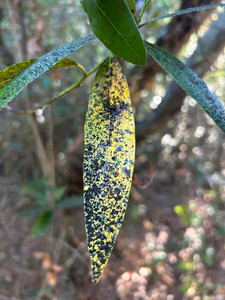


Researchers have just named the culprit, a fungus in the genus Phytophthora (pronounced Fi-TOF-thor-uh), but have yet to devise a strategy to slow its path of destruction. First documented on tanoaks in 1995 by Marin County Horticultural Advisor Pavel Svirha, the disease has killed thousands of trees in Marin County and Santa Cruz County. The fungus is currently affecting three species of trees: Tanoak (Lithocarpus densiflorus), coast live oak (Quercus agrifolia) and black oak (Quercus kelloggii). The California Department of Forestry has paid little attention to the epidemic since tanoaks are of little timber value.
UC Davis plant pathologist David Rizzo, who identified the rare fungus, released his findings at the end of July to raise public awareness before the start of the rainy season, when the danger of spore dispersal through human actions will be at its highest. While it is possible that this species of Phytophthora is being dispersed by air, the spores are most likely spread by hikers' shoes and animals' feet, bicycle and car tires, infected firewood, and soil moved in construction areas, according to Rizzo. Preventing the movement of soil and wood will be critical to slowing the spread of the fungus to other oak woodlands, he said. Obviously, mushroom hunters who travel frequently to different forests should be especially careful to clean off their hiking boots and tires after visiting coastal woodlands. Since so little is known about the biology of this organism, the research team recommends taking these extra precautions, based on how other Phytophthora species are disseminated.
Phytophthora is related to the fungus that caused the Irish potato famine. but Rizzo says it does not match any of the 60 known Phytophthora species anywhere in the world. How it came to Mill Valley remains a mystery. This new Phytophthora appears to like the cool, wet conditions typically found along the California coastline. In petri dishes in the laboratory, its colonies resemble clusters of cotton fiber, and can produce thousands of offspring in just twenty-four hours. The offspring, called zoospores, are released from tiny lemon-shaped sacs called sporangia. The sporangia may become airborne in wind and active with moisture, so fog and moderate summer temperatures are ideal for its reproduction and dispersal.
Once in the tree, Phytophthora produces enzymes that dissolve the dead outer and living inner layers of bark. Oozing sores result as the cell walls break down and cankers form on the outer bark layer, often the first visible sign of trouble.

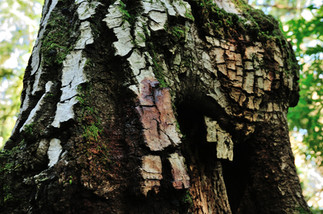


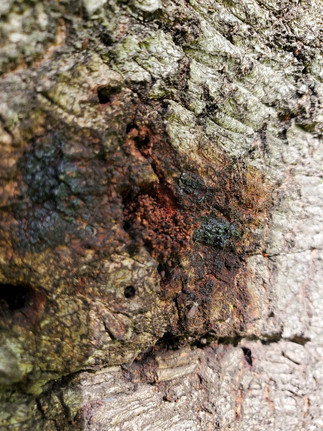
As the disease progresses past the bark, the tree then becomes vulnerable to invasion by bark beetles, originally thought to be the cause of sudden oak death syndrome. Three beetles have been found on affected trees: the Western Oak Bark Beetle, the Oak Ambrosia Bark Beetle, and the Minor Oak Ambrosia Bark Beetle. Through years of studying the progression of the disease, scientists now know that the beetles are not capable of invading healthy trees, but can be very destructive once trees are weakened.
Finally, after the layers of bark are destroyed and the beetles have drilled through the wood, another fungus, Hypoxylon thouarsianum (now Annulohypoxylon thouarsianum) a wood-rotting ascomycete, invades the tree and forms its characteristic small black fruiting bodies on the outer layer.


Rizzo says the ecological ramifications of Phytophthora are alarming. Coastal oak woodlands provide habitat for many forms of animal and plant life. There are at least one hundred species of mushrooms that grow in oak habitats, including many choice edibles.
"I hate to think of a future without live oak and tanbark oak and, of course, without chanterelles, black chanterelles, hedgehogs, Amanita velosa, Boletus aereus (misapplied, now Boletus regineus in California), and the many other oak-loving mushrooms that we cherish" says Mike Boom, former MSSF President. "As we find out about this oak plague, we must do whatever we can to help."


Tanoaks seem most susceptible to the fungus, but now that it has also been found on black oaks, David Rizzo is concerned that it could cross the central valley and thrive in the black and canyon oak woodlands of the Sierra.
So little is known about this new fungus that Rizzo and other members of the research team think immediate action to control it is called for. The scientific team initiated meetings with federal forest officials in August about quarantine gating-off of uninfected forests in the winter during the wet season, the same strategy now being used to protect Port Orford cedar trees in Northern California and Oregon from a similar fungus.
Ecological systems change over time, and often change is swift. One thing is known: this species of Phytophthora is in our woodlands, and we will have to adjust.
For more information, the UC Berkeley website has current information on research and monitoring activities. The website of the University of California Cooperative Extension Program in Marin County is also a good source of information.
Editor's note: The original links have been decommissioned. More recent references are here, as of 2026:
California Oak Mortality Task Force
https://www.suddenoakdeath.org/about-california-oak-mortality-task-force/
Phytophthora ramorum and sudden oak death in California: III. preliminary studies in pathogen genetics
https://research.fs.usda.gov/treesearch/26172
Sudden Oak Death Research, Santa Lucia Conservancy
https://slconservancy.org/sudden-oak-death/
Sudden Oak Death Disease Locations and Monitoring, UCCE Humboldt - Del Norte Counties
https://ucanr.edu/county/ucce-humboldt-del-norte-counties/sudden-oak-death-disease-locations-and-monitoring
Forest Health, UC Cooperative Extension Marin County
https://ucanr.edu/county/marin-county/forest-health
This article was simultaneously published with permission in the September 2000 issue of Mycena News and Duff. Some information in this article has been added or updated (such as Latin names, links, and images).
%20(from%20inaturalist_org%2C%20obs_%20112123956).jpg)
.jpg)