332 results found with an empty search
- FFSC Scholarship Awarded to Alison McGregor | Fungus Federation of Santa Cruz
News & Stories / FFSC Scholarship Awarded to Alison McGregor The Scholarship Committee has awarded funds to UCSC student Alison McGregor in order for her to purchase a microscope to better pursue her mycological studies. Marje Young • May 2, 2012 Microscope Lenses (stock photo) She writes: “I am interested in the species diversity and composition of Santa Cruz crustose lichen communities, and in exploring novel methods of propagating local species of mycorrhizal fungi for the purpose of myco-restoration. I dream of conducting crustose lichen surveys in the coastal ecosystems and the urban surfaces of Santa Cruz. These surveys require the observation of spore size, type and number per ascus to diagnose the details of reproductive structures. With a microscope I could identify samples and create herbarium specimens for UCSC’s Museum of Natural History Collections. “My other major pursuit is to develop the skills necessary to nourish and rejuvenate disturbed and decimated ecosystems. With the aid of a microscope, I will be able to inspect spores to ascertain species and observe the morphological characteristics of fungal spawn. Over time, I can use this knowledge to introduce appropriate mycorrhizal fungi to aid in the recovery of disturbed, poisoned and eroded habitats inbackyards and agricultural watersheds of Santa Cruz.” The FFSC looks forward to having Alison speak to us about her many projects. Marjorie Young and Phil Carpenter Scholarship Committee Members Only Content Login Join FFSC Related Posts Previous Article All News & Stories Next Article
- A Very Mushroomy Halloween To You, Too! | Fungus Federation of Santa Cruz
News & Stories / Mycology & Art News A Very Mushroomy Halloween To You, Too! Halloween is fast approaching, and this is Santa Cruz’s favorite holiday. Are your kids dressing up? Are you? Deb • September 27, 2013 Omphalotus olivascens (western Jack o'Lantern) at the Fungus Fair Julian and Gabriel sported magnificent Muscaria costumes while out trick-or-treating with their family and some friendly elves last year. We can’t wait to see what they do this year, and would love to see your costumes, too! Send photos to our Google Group or Facebook group. Larger images are preferable, thanks. For further inspiration, visit Pinterest: http://www.pinterest.com/search/pins/?q=mushroom%20costume Members Only Content Login Join FFSC Related Posts Haikus Celebrating the Secret Life of Fungi Previous Article All News & Stories Next Article
- FFSC 37th Annual Fungus Fair Rocked | Fungus Federation of Santa Cruz
News & Stories / Fair News FFSC 37th Annual Fungus Fair Rocked On Friday, January 7, 2011, I’m standing at the back of the stage at the Louden Nelson Center, around 3:00 pm. I’m taking a moment’s breath, and I’m thinking, “What if nobody comes?” Rene Barone • February 1, 2011 Ticket line at the 37th Fungus Fair. Photo by Hugh Smith What if, after all this work, nobody shows up for the first Friday the Fungus Fair is open to the public? Well, four hours, 435 patrons and numerous volunteers later, the 37th Fungus Fair was well on its way to success. Saturday and Sunday followed suit with new attendance records set. Thank you one and all for your attendance and volunteer efforts. I am humbled by your enthusiasm in helping us to accomplish our goals of providing mycological education and helping to keep the fun in fungi. Rene Barone Co-chair FFSC gratefully acknowledges our Fair Co-Chairs, Phil Carpenter and Rene Barone for their many months of hard work and planning. Their tireless and cheerful leadership made this the best Fungus Fair ever. Providing supporting roles were the many members of the Fair Committee and the Group Coordinators. And, those amazing engineers of our new display island—Fred Molner and Ron Bader! And to our Many Many Enthusiastic Volunteers – We Can’t Do It Without You! Members Only Content Login Join FFSC Related Posts 40th Fungus Fair: Time lapse of the Island setup A Short History of the Fungus Fair Previous Article All News & Stories Next Article
- A Tale of Ozark Shiitake Growing | Fungus Federation of Santa Cruz
News & Stories / A Tale of Ozark Shiitake Growing Living in the Ozark woods brought out an interest in Fungi. Mushrooms... wild, exotic, forbidden fruit for the picking. But never enough...! Why not grow my own? Bo Letos • November 2, 2009 Lentinula edodes. © Alan Rockefeller (mushroomobserver.org) Calling one of many commercial suppliers resulted in a wide range strain of spawn shipped to my door. After thinning out a variety of oaks trees, I had a few dozen gently collected fresh logs, about 3-4 feet long. The suggested optimal log harvest time for sugar and water content is mid-to-late winter. My shiitake mushrooms grow in logs. Photo by the author After drilling a cross-hatch pattern of 1/2 inch holes in the logs, a spawn laced plug was placed in each hole and sealed with a paint-brush stroke of not-to-hot liquid wax. Soon a white patch with blackened edges will appear under the wax. Hmmm... Is this fungi? After a nice growing season with a little water and rain, the Shiitake come bursting out of the wax. Time now for the one-of-a-kind luxury of popping small tender crumbly pinhead primordia straight from log to mouth. I know where this mushroom has been. ( Editor’s note: cooking mushrooms thoroughly prior to consumption is generally advised, but this is a tiny taste indeed.) Commercial mushroom cultivation in the Ozarks uses oak sawdust, water, and rabbit food (yep), placed in tubular plastic with rubber bands holding each end of the foot long “log”. After being cooked, a pencil shaped dowel injected with Shiitake spores is poked in one end. The logs are placed in a warm dry room and grow quickly. The stiff brown skinned logs are next placed in the rain room, minus plastic. Fresh cool humid air is pumped in with five minutes of sprinkler rain every few hours, resulting in commercial grade Shiitake. Commercial Shiitake often have uniformly smooth brown caps. The home grower may have a variety of beautiful strains and environments. Shaggier caps or cracked caps from colder drier environments are more highly valued and UV exposure increases vitamin D content. If placing your logs outside, give some thought to the ground the log resides upon. The log can wick up moisture from the ground along with whatever chemical substances that are in the ground. For instance the shady side of your house under the drip edge of the roof is an easy and convenient location, but consider the variety and strong doses of long-lasting termite and insecticides that may lurk underneath the surface. Think about an “organic” growing site. Author- Unknown Hillbilly (by request) Members Only Content Login Join FFSC Related Posts Ain't No Cure for the Summertime Blues Previous Article All News & Stories Next Article
- Ain't No Cure for the Summertime Blues | Fungus Federation of Santa Cruz
News & Stories / Ain't No Cure for the Summertime Blues Eddie Cochran sang it in 1958, but it ain’t necessarily so. Miss mushroom hunting in the summer and can’t travel to warm summer rain areas? Why not try your hand at mushroom cultivation. It is challenging, but quite rewarding. Jim Maley • December 1, 2009 Pleurotus ostreatus. © Debbie Viess (from mushroomobserver.org) I realize it is December but now is the time to gather your materials and prepare for spring cultivation. Remember, daffodils bloom here in late winter and warmer mushroom cultivation temperatures follow closely behind. I have been reasonably successful at finding great mushrooms with the help of many FFSC gurus. And, through my involvement in the Master Gardener program , I certainly know how to grow vegetables. Mushroom cultivation skills though, have eluded me until recently. The breakthrough was turning my “green thumb” white slowly but surely. Yes the “white thumb” as MSSF’s Ken Litchfield calls it, does help. There is a lot to learn on the subject. I’m learning more through simple steps such as starting with easy varieties like Oyster Mushrooms. With my busy holiday schedule, I do not have time to fully discuss what I have learned, so I am referring the reader to our first Master Gardener Program report on the subject. Yellow and Blue Oyster Mushrooms. Photo by Jim Maley We are in the second phase of the mushroom trial project for Blue and Yellow Oyster cultivation. I’m busy documenting and quantifying what we have learned with our various approaches. Our third phase will expand to Shiitake Mushrooms and garden varieties such as the King Stropharia and maybe the Shaggy Parasol. The key to success is “fighting the competition” of ever present molds in the air using both pasteurization and sterilization techniques. We also get big help from a fine Laminar Flow Hood for clean air and culture transfers donated to our Master Gardener program by FFSC’s own Henry Young. There are some less exotic approaches to the problem, which I hope to describe in future issues as we learn more. Oh, so you turn up your nose with Oyster Mushrooms? Just try using mushrooms in the India Joze recipe for fritters with Skordalia sauce. Jozseph Schultz can make an Oyster Mushroom sing and so can you. Jim Maley UCCE Master Gardener SCC Members Only Content Login Join FFSC Related Posts Previous Article All News & Stories Next Article
- Bioluminescent Mushrooms from Spirits of the Forest | Fungus Federation of Santa Cruz
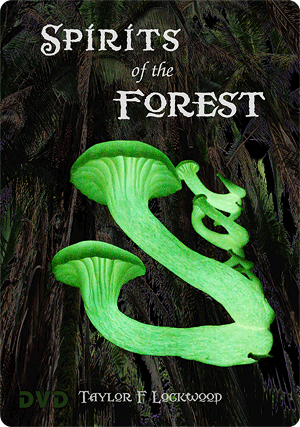
News & Stories / Bioluminescent Mushrooms from Spirits of the Forest Bioluminescent mushrooms and classical music from Taylor F. Lockwood. Yevgeny Nyden • November 22, 2013 Cover of Spirits of the Forest DVD (from mushroom.pro). Copyright 2016 Taylor F. Lockwood Enjoy this beautiful video of bioluminescent mushrooms accompanied by classical music, from Taylor Lockwood's "Spirits of the Forest" DVD. Members Only Content Login Join FFSC Related Posts Cam Cam by Taylor Lockwood Taylor Lockwood's National Geographic Magazine Debut Previous Article All News & Stories Next Article
- Bradley's Secret Spot | Fungus Federation of Santa Cruz
News & Stories / Bradley's Secret Spot Today, in the woods, I saw a little lump in the pine needle duff… Bradley Dunbaugh • December 2, 2009 Bolete under dufff. Photo by Bradley Dunbaugh Members Only Content Login Join FFSC Related Posts Previous Article All News & Stories Next Article
- 2026 Santa Cruz Fungus Fair: Our Mission in Action | Fungus Federation of Santa Cruz
News & Stories / 2026 Santa Cruz Fungus Fair: Our Mission in Action The Fungus Federation of Santa Cruz exists to expand the understanding and appreciation of mycology through education; and to assist the public, institutions, and partner organizations in advancing that goal--and keeping the FUN in fungi. The 2026 Santa Cruz Fungus Fair brought all of these groups together to make high-quality mycological education accessible to thousands of people, while producing real scientific output and supporting local arts, culture and economic development. Peter Mu • January 20, 2026 Visitors enjoying outdoor vendors at the 2026 Fair This year, the 52nd fair reached more people, more deeply, than ever before. More than 3,500 attendees joined us over the weekend. 12 educational talks drew an estimated 1,100 participants, while 300+ children and adults explored hands-on learning through mushroom crafts, dyeing, face painting, and creative play. 75 guests gathered for a special after-hours mushroom dinner and wine pairings. It was also an exceptional year for mycological research: 275 mushroom specimens were collected, sampled, and submitted for DNA sequencing during the Fair, contributing valuable data to the broader scientific community and advancing our shared knowledge of fungal biodiversity. Plus, over 6,800 mushroom observations were recorded in the 2026 Santa Cruz Fungus Fair MycoBlitz project on iNaturalist. The Fair reinvested directly into the local ecosystem—paying over $6,000 to speakers, mycologists and students; supporting partners such as the London Nelson Community Center and the Museum of Natural History; and providing 26 local artisans and small businesses with vending opportunities , while incurring no overhead cost to FFSC. None of this happens without volunteers. 169 volunteers filled 94.9% of all positions during the Fair, contributing over 500 hours of service collectively. Volunteers collected and identified specimens, set up and disassembled exhibits, staffed doors and tables, loaded and unloaded trucks, educated the community, and supported each other. Many of you committed your entire weekend and more to the event. The Fungus Fair is more than an annual event. It is a living expression of FFSC’s mission—education made accessible, science made communal, and appreciation for fungi shared widely. I’d like to take a moment to express my deeply felt gratitude towards all the volunteers who made the event possible--especially to members of the Fungus Fair Committee who tirelessly volunteered throughout the year to plan and implement this event. Thank you. Peter Mu Co-Chair, Santa Cruz Fungus Fair Committee Keeping the FUN in FUNgus at the 2026 Fair After Hours Dinner Members Only Content Login Join FFSC Related Posts A Short History of the Fungus Fair Santa Cruz Fungus Fair Logo Design Contest 2026 Previous Article All News & Stories Next Article
- Cam Cam by Taylor Lockwood | Fungus Federation of Santa Cruz
News & Stories / Mycology & Art News Cam Cam by Taylor Lockwood Cam Cam is a short video of mushrooms and original music by Taylor Lockwood. Yevgeny Nyden • June 21, 2014 A photo from Taylor's "Cam Cam" YouTube video. © Taylor Lockwood A short video clip from Taylor F. Lockwood: Cam Cam (39 seconds) with some of his new "Brazilian" music. It will be included in Taylor's latest video project, Spirits of the Forest. Members Only Content Login Join FFSC Related Posts Taylor Lockwood's National Geographic Magazine Debut Bioluminescent Mushrooms from Spirits of the Forest Previous Article All News & Stories Next Article
- Albion II, 2011 – Great Forays, Fungi and Food | Fungus Federation of Santa Cruz
News & Stories / Albion II, 2011 – Great Forays, Fungi and Food The Albion II Foray was very successful with full attendance of 58 participants, all blessed by nice weather. Species collectors identified 124 species, and our infamous Saturday night potluck featured many delights. Wendy Wells • February 1, 2011 Hedgehog (Hydnum repandum). Photo by Yevgeny Nyden Members Only Content Login Join FFSC Related Posts Albion I, 2010 – A Great Time for All Previous Article All News & Stories Next Article
- Elections 2013: Wednesday May 15th | Fungus Federation of Santa Cruz
News & Stories / Stewardship Elections 2013: Wednesday May 15th Cast your vote and celebrate with a sparkling wine toast! Isn’t democracy great? In fact, if you’re mulling over taking on a position but are still undecided, a glass to help you decide can be arranged before voting... Phil Carpenter • May 1, 2013 General Meeting The FFSC Bylaws call for election of Club Ministers (Officers) every two years. We are now at the end of the current two year term and re-election of Ministers will be conducted at our last regular meeting of this mushroom season in May. Our bylaws also call for a slate of Ministers nominated for the next season to be announced in the April and May issues of the DUFF . At the April general meeting, the Ministers nominated were announced and additional nominations from the floor were taken. The slate to date is printed below. Duties of the various Ministers can be seen in the bylaws. This notice is a call for nominations for the elected Minister positions. If you are interested in doing some interesting and rewarding work, please notify me regarding the position you are interested in. While some Ministers have graciously consented to continue their positions for another two years, all positions noted below are open for nomination (volunteering) and election. We would welcome the chance to have two people vying for a position! As someone who has been a Minister for most of the 25+ years that the FFSC has been around, I can attest that it is a lot of fun (the monthly Minister’s meetings alone are worth it!) and a great group of which to be a part. Consider joining us! Phil Carpenter Prime Minister Members Only Content Login Join FFSC Related Posts FFSC Minister Elections 2013 Previous Article All News & Stories Next Article
- Spring Fungi of the Sierra Nevada - 2026 Recap | Fungus Federation of Santa Cruz
News & Stories / Spring Fungi of the Sierra Nevada - 2026 Recap Each spring, the retreat of the snowpack provides a unique ecological window of opportunity for “snowbank fungi”, a group of mushrooms that (as the name suggests) grow in and around snowbanks. As spring gives way to summer, curious mycophiles from around the world gather at a rustic campus in Tahoe National Forest to study these fascinating fungi. Lisa Tesler • June 18, 2026 Snowbank fungi (Mycena overholtsii). Photo by Lisa Tesler At the beginning of June, my mom and I headed up to the Tahoe area to participate in Spring Fungi of the Sierra Nevada . This is a 5-day mycology course designed for absolute beginners and experienced mycophiles alike. Snowbank fungi are endemic to the high-elevation coniferous forests of western North America, where short, cold summers allow snowbank remnants to linger into August. To help others learn about these interesting species, the renowned mycologist Dr. Harry D. Thiers created this course in 1982. Over the years, other instuctors have included Dr. Roy Halling , Dr. Andrew Methven , and Dr. Dennis E. Desjardin . As of 2017, Dr. Brian Perry has been leading the course. Dr. Perry maintains a detailed species list and grows it each year. So in lieu of a field report, here's a recap of what we experienced in this year's course. The Campus Setting Daily Activities Course Registration Final Comments The Campus Setting Sierra Nevada Field Campus sign. Photo by Lisa Tesler The academic setting is SF State's Sierra Nevada Field Campus, a semi-rustic outpost tucked off Highway 49 , along the North Yuba River in the Tahoe National Forest. Due to limited funding and historic preservation agreements, this campus' architecture sits somewhere between a 1970s research station and a U.S. Forest Service campground. In fact, a non-profit group, Friends of the SNFC , and the university are both seeking donations to improve student amenities and the facilities. ( More info below ) The campus center is a two-story wooden building, housing a single communal classroom downstairs, along with bathrooms and showers, and a dining hall upstairs. For this course, Dr. Perry (Brian) converted the classroom’s long tables into rows of temporary lab workstations. Each workstation included a compound microscope plus basic supplies (razor blade, forceps, slides, cover slips and lens wipes). Pairs of students also shared a dissecting scope and an assortment of diagnostic reagents. Our classmates included a few mother/daughter participants (like my mom and me), as well as couples and friends who had come up together. So the pairs formed quickly, and those who came solo synced up to form the remaining pairs. Other buildings on the property include housing for the campus director, teaching staff, etc., as well as forest-service-style showers and bathrooms at both ends of the campus for students who were camping. On-Site Lodging Tent photo from https://sierra.sfsu.edu/gallery-0 Most students rented large canvas-wall tents built on wooden platforms (which were apparently pretty comfortable), or pitched their own tents among the pines. Alternatively, some people slept in their own camper vans or trailers in the parking lot across the river. (For our own accessibility and health reasons, my mom and I opted to stay in Sierra City, about 10 minutes away.) Due to an aging bridge and limited budget for road maintenance, students who camped could drive to their tents to unload/load gear on the first and last day, but otherwise we were all asked to leave our cars in the main parking lot during the week. Food Options As this is bear country, the campus provided an industrial refrigerator in the dining hall for personal perishables, plus shelves for non-perishables. If you attend this course and opt in to camping on campus, please note that the kitchen was for staff only, and students were asked not to cook or have food in their tents. Campus chefs typically prepare one tasty main dish per meal (with variants for meat-eaters and vegetarians). When we were there, they offered stroganoff, Chilaquiles, Taco Tuesday, etc. and incorporated wild mushrooms as available. They also laid out self-service buffets for morning cereal, brown-bag lunches, and evening salads. Daily Activities We followed a regular daily schedule, with each activity building on what we had learned in the morning earlier in the week: Morning Lecture Daily Foray(s) Afternoon Lab Session Evening Talk Morning Lecture Each morning after breakfast, we gathered at 8:15am for a lecture in the dining hall. Dr. Brian Perry started the week with lectures on macro- and micro-morphological characteristics. As the week progressed, he shifted to beautiful slides covering the taxonomy of local Spring basidiomycetes and ascomycetes. (Heh--for my part, I spent most of that time taking notes on how Brian pronounced the Latin names--much to my mom’s amusement, along with her observations about California’s high school education system no longer requiring Latin...) Daily Foray(s) View of the Yuba River from the the Sierra Nevada Field Campus bridge. Photo by Lisa Tesler At around 10:30am each day, we packed up our lunches and baskets, and we headed outdoors. After a short walk across the Yuba River, we gathered in the parking lot, while enjoying the fresh air and a swarm of California Tortoiseshell butterflies. From there, we carpooled along Highway 49 to seek the types of fungi we had studied so far. Some participants were experienced snowbank mushroom foragers, and seemed to easily find interesting species left and right. Others initially found the hunting to be a little more challenging--especially if used to hunting for large edibles in areas where the mushrooms practically stand up and wave at you. With some time, everyone still found plenty to study for the class. On the first day, a fellow participant whom my mom befriended approached our car during a break, reverently holding a beautiful Spring King. “It’s the first porcini I’ve ever found, after all these years!” she bubbled. We congratulated her, and my mom asked if she was planning to prepare a special meal with it. “I’m going to donate it to the campus kitchen, so everyone can enjoy it!” she replied with delight and generosity. Another delightful foray location was at around 7,000 feet, where the air was cooler, and the mosquitoes were still blessedly dormant. Hunting here was familiar and yet different (compared to our typical FFSC forays). For this hunt, we started by looking for patches of snow. Then, with sunglasses and face masks on for sun protection, we carefully peered under and around the melting edges of the snowbanks. Note: One passerby was clearly baffled to see people surrounding snowbanks near the road, each of us hunched over, squatting, or nearly lying down amongst broken logs and rocks. In this habitat, we found elegant mushrooms like the snowbank fairy helmet ( Mycena overholtsii ). This is a paradoxical giant among the usually tiny mycenoids, growing up to 6 inches tall, with caps over 2 inches wide. Like other snowbank fungi, their fruiting bodies are just warm enough to melt small caverns in the snow, allowing them to grow tall until they break through the surface (or the snow melts away) to release their spores. The snowmelt also created an ideal habitat for spring orange peel fungi ( Caloscypha fulgens ), black snowbank cups ( Donadinia nigella ), and other beauties. On another foray, we visited a wide open area at around 5,000 feet, where we found more black snowbank cups, along with bird’s nest fungi, and more. One day after lunch, some people began a little show-and-tell and “what is it?” with Brian and others. My mom took the opportunity to rest, so in the last few minutes before we left the area, I strolled back to revisit some trees where I had seen a couple of large, decomposing porcini, but I still didn’t find any others. Basket with Porcini ( Boletus rex-veris ) That is, of course, until I experienced the classic foray trope: On the way back to my car, right smack in the middle of the area where 20 other students had just been hunting for over an hour, three robust porcini caps peeked out at me from under pine needle ‘shrumps, like sleepy foreheads emerging from blankets after a long winter slumber. With strategic mercy, Brian saved the wettest and most mosquito-choked habitats for Thursday, our last day of foraging. Some of the rarer high Sierra species only grow in marsh grasses or tucked into soaked logs, so upon arriving at this soggy location, students donned sandals and/or rubber boots—and a lot of mosquito repellent—to see if they could find some rarities. My mom and I didn’t find any of the rare specimens, but we were at least pleasantly rewarded with other enjoyable species. The group forays typically ended at around 2pm, giving everyone time to hunt at their own secret spots, rest/shower, or get ice cream at the Bassett’s Station Store. (My mom reported that the ice cream was very good.) At 3pm, we reconvened in the coolness of the lab. Afternoon Lab Session On our first afternoon in the lab, Brian briefly reviewed the morphological characteristics of basidiomycetes. Assistant instructor Taye Bright made sure everyone had at least one mushroom of the same species, and then they led us through a traditional group ID session. We used a set of dichotomous keys which Brian and Dennis Desjardin had developed for the course. (If you’re not familiar with dichotomous keys, think of an eye exam where you are asked to choose “A or B?”, and then each answer takes you to the next “A or B” question until you drill down to the species.) Next, we used our microscopes to look at the mushroom’s spores, to ensure everyone was able to see the same shapes. On Tuesday, we reviewed how to study more complex microscopic features, and Taye walked us through another ID session as a group. From then on, each of us began to work at our own pace in the lab—given that some students were professional biologists, and others were microscopy newbies. Several course alumni and guest advisors joined the sessions for the first few days, including Mike Woods , Douglas Smith , Dr. Andrew Wilson , and others. Thus, those of us who were new to microscopy (or who hadn’t touched a microscope since high school) got plenty of one-on-one help. They showed us (or in some cases re-showed us) how to prepare a basic squash mount, operate the microscope, understand which parts of different specimens to dissect, etc. Note : If you’ve attended this course in the past, Dr. Perry said alumni are welcome and encouraged to come back as guest advisors. You can join the forays, assist students in the lab, and sit in on lectures. Evening Talks (and Final Exam Day) After dinner each evening, students could attend optional evening talks, gather around picnic tables to socialize, or do their own thing. This year's speakers were Brian, Dr. Andrew Wilson , and campus Director Lynx Gallagher. In addition, J.R. Blair led an evening trip to go birding in the Sierra Valley. Tortoiseshell butterfly taking the final exam? Photo by Niecea Freeman On Friday morning, the instructors set out several specimens on those same picnic tables, with test questions as a final exam. (This was an open-book test, mostly for ourselves.) By Friday, my mom and I were mentally and physically exhausted, but happy about what we’d learned. Despite being tired on the drive home, we couldn’t resist stopping a few times to explore potential foray areas. “Let’s just look for 5 minutes…” we’d say, and then of course we’d poke around for 20 minutes. Knowing we still had a long drive back to the Monterey Bay Area, we finally agreed “This is the last spot!” The elevation was lower and the ground was pretty dry by then. We only found the remains of one morel, some Dyer's polypore ( Phaeolus schweinitzii ), and not much else. “Time to go,” said mom. But then, once again, while walking back toward the car, I noticed a clearing where the sun lit a pile of pine needles on an odd-looking rock. “Hmm… Is that a rock, or could it be a ‘shrump?” I wondered, and detoured over. Sure enough, another three porcini!! A tasty end to a long week. Boletus rex-veris on the way home. Photo by Lisa Tesler Course Registration Speaking of porcini, this year the course registration fee was $395 (plus meals and camping fees). Given the price of fresh morels and porcini at my local fine foods store, the edibles we found on this trip were probably worth about the same as the class fee! Even if you don’t look at the pricing that way, many commercial half-day and weekend ID classes range from $100-$150 per day and only have enough time to cover a fraction of this course’s depth. SNFC classes are treated like part of an extension program, which means you don’t need to be a matriculated student at SF State (or anywhere else) to take this course. In fact, this year’s cohort ranged from teenagers to octogenarians, and beginners to biologists. It should be noted that this course may be canceled if conditions are overly dry (as occurred in 2014 ). In fact, Brian normally co-leads a course with Alison Pollack the following week ( Myxomycetes of the Sierra Nevada ), but that course was canceled this year, due to inopportune conditions. Scholarship (and Donation) Options If you’re hesitant or unable to afford the $400 investment, I would encourage interested students and members to apply for an FFSC scholarship to cover (or at least offset) the fees. A non-profit group, Friends of the Sierra Nevada Field Campus , also offers scholarships for this course-and for any other SNFC courses and workshops. The Friends group also accepts tax-deductible donations . Over the years they've successfully funded many of the amenities that affect day-to-day campus life. Plus, the university is seeking larger donations to help fund infrastructure improvements to the bridge and buildings. Final Comments If you’re not interested in fungi that grow in the Sierra Nevada, there are many excellent courses in the Bay Area (including through FFSC ) that can teach you how to use dichotomous keys and/or how to use a microscope. That said, the length and depth of the Spring Fungi of the Sierra Nevada course (not to mention the lack of cellular, WiFi, and TV distractions) gives you a unique opportunity to focus (no pun intended) on your microscopy and ID skills. After you learn a skill, you get several more days of practice with attentive instructors and advisors in the room. They’ll answer your “Did I get this one right?” questions in real time, troubleshoot your squash mounts, and/or thumb through the keys alongside you to figure out why you went down an unexpected path. And it's a lot of fun! Where to Learn More about the Course In this YouTube video, Dr. Brian Perry gives an overview of what he covers in the course. You can read more about snowbank fungi in the Spring 2009 issue of Fungi Magazine : https://www.fungimag.com/spring-09-articles/13_Snow.pdf Members Only Content Login Join FFSC Related Posts Spring Fungi of the Sierra Nevada, June 2013 Microscopy of Gilled Mushrooms Previous Article All News & Stories Next Article